How to Turn Hardware Acceleration On or Off in Firefox

To turn off hardware acceleration in Firefox, open the menu (three horizontal lines), select Settings and stay in the General panel. Scroll to Performance, uncheck "Use recommended performance settings", then uncheck "Use hardware acceleration when available". Quit and restart Firefox. To turn it back on, tick the same box again and restart. You can confirm the result on the about:support page under Graphics.
This guide covers what the setting does, both directions of the toggle, how to verify the current state, the about:config and policy equivalents, and which symptoms are worth testing with acceleration off.
What hardware acceleration does in Firefox
Hardware acceleration lets Firefox hand graphics work to the graphics processor (GPU) instead of doing everything on the central processor (CPU). Mozilla describes it as using the GPU for video, games and animations. In practice this covers page rendering through WebRender, Firefox's GPU-based rendering engine, plus video decoding and WebGL content.
On a system with a working GPU and current drivers, leaving acceleration on is the better default: scrolling stays smooth, video playback uses less CPU and pages with heavy animation stay responsive. With acceleration off, Firefox renders in software on the CPU, which can raise Firefox CPU usage on Windows 11 and other systems, especially during video playback.
Problems start when the graphics driver and Firefox do not cooperate. Mozilla notes that with some graphics setups Firefox "may crash or have trouble showing text or objects on pages". That is the main reason to switch the setting off, and in most cases it is a diagnostic step or a temporary workaround until a driver update fixes the cause.
One limitation: Firefox hides the hardware acceleration option when your graphics driver is not compatible, so on some systems the checkbox does not appear at all.
How to turn off hardware acceleration in Firefox
Firefox's hardware acceleration switch sits in the Performance section of Settings, behind the recommended-settings checkbox. The steps are the same on Windows, macOS and Linux:
- Click the menu button (three horizontal lines) in the top-right corner and select Settings. On some Mac versions the item may be labeled Preferences.
- Stay in the General panel. In newer releases with the redesigned Settings page, select Tabs and browsing in the left sidebar.
- Scroll to the Performance section.
- Uncheck "Use recommended performance settings". The hardware acceleration option appears below it.
- Uncheck "Use hardware acceleration when available".
- Fully quit Firefox and start it again. The change only applies after a restart.
If you want to test before changing anything permanently, use Troubleshoot Mode instead: open the menu, go to Help (Help and Report in some versions), select Troubleshoot Mode and confirm the restart. You can also hold Shift (Option on a Mac) while starting Firefox. Troubleshoot Mode temporarily disables extensions, uses the default theme and turns off hardware acceleration. If a problem disappears there, retest with only acceleration off to see which of the three was responsible.
How to turn hardware acceleration back on
Turning hardware acceleration back on in Firefox is the same path in reverse. Open Settings, go to General (or Tabs and browsing) and scroll to Performance. Either tick "Use hardware acceleration when available" on its own, or tick "Use recommended performance settings", which hands the decision back to Firefox and enables acceleration whenever your hardware and driver are supported. Restart Firefox afterwards.
Switching it back on makes sense after you update the graphics driver, after a Firefox update that mentions graphics fixes, or when you notice choppy video, sluggish scrolling or high CPU load with acceleration off. If the original glitch returns, turn it off again and keep it off until a newer driver is available.
How to check whether hardware acceleration is active (about:support)
The about:support page shows whether Firefox actually renders on the GPU, which the Settings checkbox alone cannot tell you. Type about:support in the address bar, press Enter and scroll to the Graphics section.
- Look at the Compositing line. "WebRender" means Firefox is rendering on the GPU. "WebRender (Software)" means it is rendering on the CPU, either because you disabled acceleration or because Firefox fell back to software mode.
- Check the GPU entries to see which graphics card and driver version Firefox detected.
- Scroll to the Decision Log. It lists rendering features with their status, for example blocked by the driver or disabled by a preference.
This check matters because Firefox can drop to software rendering on its own, for example after a GPU process crash or on driver versions it blocklists. If Compositing shows software mode while the Settings box is ticked, the cause is the driver or the system, not your setting, and updating the graphics driver is the next step.
Advanced: about:config and policy settings
The Settings checkbox maps to the preference layers.acceleration.disabled in about:config. When the box is ticked the value is false; when it is unticked the value is true. You can change it directly:
- Type about:config in the address bar and accept the warning.
- Search for layers.acceleration.disabled.
- Toggle it to true to disable acceleration, or false to enable it.
- Restart Firefox.
If the setting keeps reverting after a restart, check for a user.js file in your profile folder or an enterprise policy that overrides it. On managed computers, administrators control this with the HardwareAcceleration policy, documented in Mozilla's Firefox enterprise policy templates; when a policy sets it, the option is locked in Settings. On Linux, Firefox builds from a distribution's package manager may also have some settings controlled by the system.
When to disable hardware acceleration
Disabling hardware acceleration in Firefox is worth testing when the symptom points to the graphics pipeline. Mozilla names video flickering or playback problems, high GPU temperatures while browsing and crashes tied to graphics drivers. The table sorts common symptoms by whether this setting is a likely fix.
| Symptom | Try disabling acceleration? | Note |
|---|---|---|
| Black, green or flickering video | Yes | Classic driver or decoding issue |
| Garbled text, missing page elements, screen tearing | Yes | Rendering problem on the GPU |
| Crashes that mention graphics drivers | Yes | Update the driver as well |
| High GPU temperature while browsing | Yes | Expect higher CPU use instead |
| Slow page loads | Rarely | Usually network, extensions or the site |
| High CPU use during video | No, turn it on | Software rendering moves work to the CPU |
If disabling acceleration fixes the problem, update your graphics driver from the GPU maker or your PC vendor, then turn acceleration back on and test again. Running without it permanently works, but costs smoothness and CPU time.
FAQ
Does turning off hardware acceleration save battery?
Usually not. With acceleration off the CPU does the rendering and video decoding, which is typically less efficient than the GPU, so laptops often use more power, not less.
Can I change hardware acceleration in Firefox for Android or iOS?
No. Mozilla states that the performance settings, including hardware acceleration, are not available in Firefox for Android or iOS.
Why is the hardware acceleration option missing in Settings?
Firefox hides the option when your graphics driver is not compatible, and an enterprise policy can lock it. Make sure "Use recommended performance settings" is unchecked, then check about:support and about:policies for the cause.
Does this setting affect other browsers?
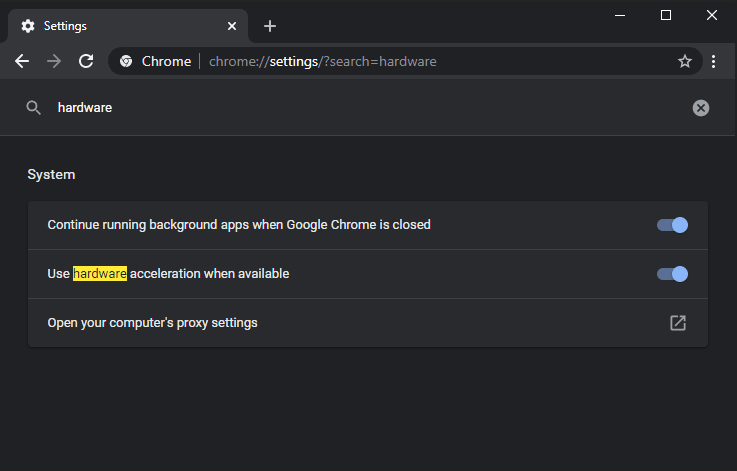
No. The Firefox setting only affects Firefox. Chrome, Edge and other browsers have their own hardware acceleration switch in their settings.
Related: block website notifications in every major browser, what uBlock Origin Lite does, Opera Browser Assistant explained

“The exciting part is that the feature can be toggled on or off in other browsers as well. Just find the option in the respective settings section.”
What the heck is so “exciting” about that?
My graphic card is AMD Radeon HD 6450 and hardware accelerator is enabled, but I think Firefox never uses GPU for video processing and always uses CPU. Why? when i disable/enable hardware accelerator in settings i don’t see any change in performance. Video playing performance in my Firefox is bad.
Type about:support in the Firefox address bar.
Scroll down to GPU#1 (and GPU#2, etc. if available) and see the yes or no status for “Active.” If no, there might be a setting in your GPU card that disallows it and maybe it can be allowed.
I don’t get it is why the screenshot is for Chrome, I found an accurate screenshot in 2-3 seconds.
There is no way a person using Firefox wrote this article…
Are these generated by AI? Why is there so many low quality articles here now?
I’m sad to see this downfall :(
Unfortunately this site is completely destroyed, Juraj, it is now a giant pile of stinking crap.