How to change tab size in Chrome
Chrome has no setting that lets you pick a tab width or height. The browser sizes tabs automatically: they start wide and shrink as you open more, down to a favicon or less. You can still control tab size in practice: pin tabs to make them icon-sized, switch to vertical tabs to see full titles, collapse tab groups to free space, or scale the whole Chrome interface to make tabs bigger or smaller.
This guide covers each method for desktop Chrome on Windows, Mac and Linux, explains why the old minimum tab width flag no longer works, and helps you pick the right option for your goal.
Why Chrome has no tab size setting
Chrome does not offer a tab size option in Settings, and the experimental flag that used to set a minimum tab width is gone. Tab width is calculated from the space available in the tab strip divided by the number of open tabs, so the only built-in ways to change it are to show fewer tabs in the strip, change the layout, or scale the browser interface.
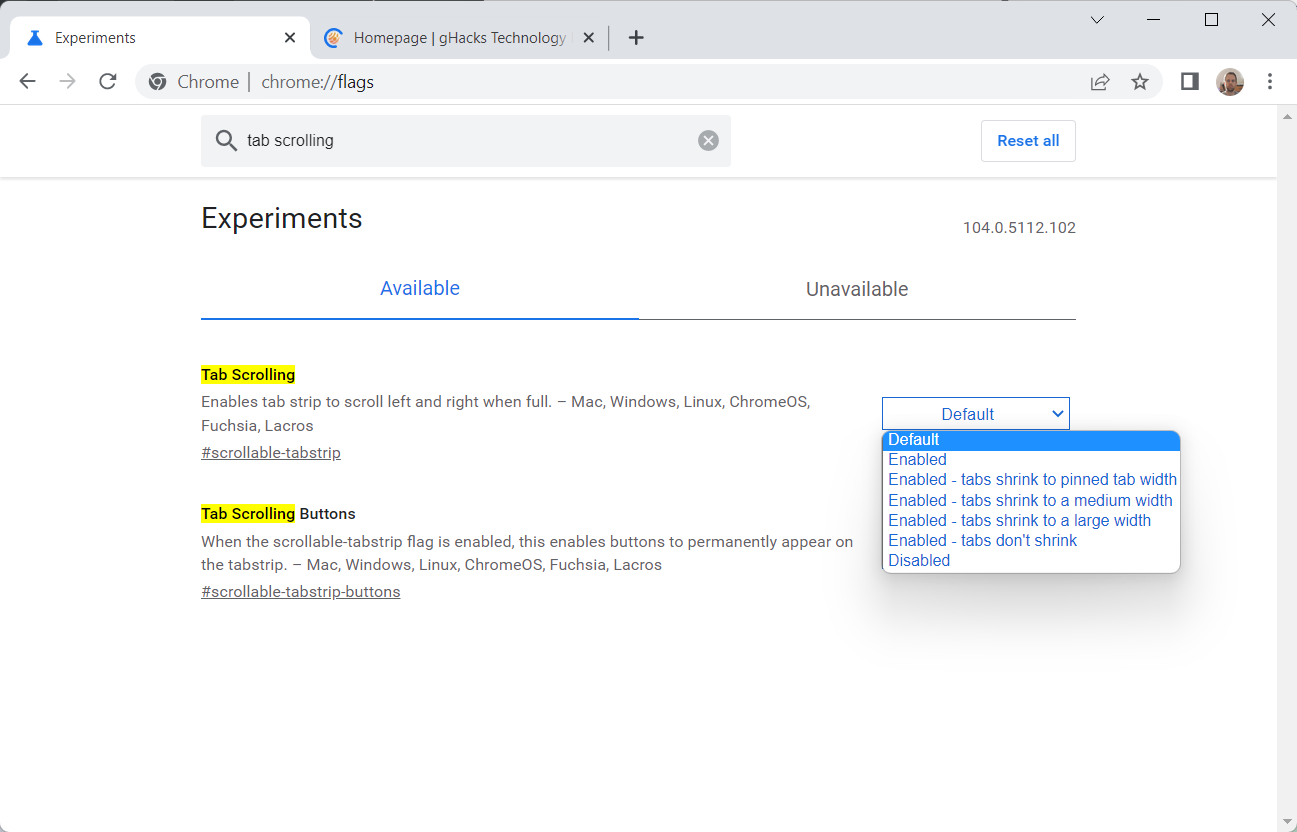
For years, the chrome://flags/#scrollable-tabstrip flag let users stop tabs from shrinking below a pinned, medium or large width, and it added scroll buttons to the tab bar. Google removed the flag in Chrome 144 in January 2026. A Google employee said at the time that there is a high-priority effort to bring tab scrolling back in a more reliable form, but no date has been given. If a guide tells you to open that flag, it is out of date.
You can still use Chrome flags to test other experimental features, but none of the current ones replaces the tab width setting.
How to make Chrome tabs smaller: pin them
Pinning is the fastest way to make a Chrome tab smaller. A pinned tab shrinks to show only the site's icon and moves to the left of the tab strip, which leaves more room for regular tabs.
- Right-click the tab you want to shrink.
- Select Pin.
- To restore the normal size, right-click the pinned tab and select Unpin.
Pinning works best for sites you keep open all day, such as mail, calendar or chat. It does not change the size of unpinned tabs directly, but every pinned tab reduces how much space the others compete for.
How to make Chrome tabs bigger: show tabs vertically
Vertical tabs are the best way to stop Chrome tabs from shrinking. Instead of squeezing tabs into the horizontal strip, Chrome lists them in a sidebar on the left of the window, where each tab shows its full page title no matter how many are open. Google began rolling the feature out to Chrome on desktop in April 2026.
- Right-click an empty area of the tab strip, or right-click any tab.
- Select Show Tabs Vertically.
- To switch back, right-click again and select Show Tabs Horizontally.
You can also set the layout in Chrome Settings: open Appearance and choose Vertical or Horizontal under Tab position. If the option is missing, update Chrome from Settings > About Chrome, as the rollout is gradual.
Free up tab bar space with tab groups and tab search
Tab groups make the remaining tabs wider by hiding the ones you are not using. A collapsed group takes up only the space of its name or colored dot, so collapsing a group of ten tabs gives that width back to everything else.
- Right-click a tab and select Add tab to group, then New group or an existing group.
- Click the group's name or colored circle in the tab strip to collapse it.
- Click it again to expand the group.
When tabs have shrunk to icons and you cannot tell them apart, use Tab Search instead of scanning the strip: press Ctrl + Shift + A on Windows and Linux or Command + Shift + A on Mac, type part of the page title, and select the tab. Closing tabs you no longer need is the other simple fix: every closed tab gives its width back to the rest.
Change the height and overall size of Chrome tabs with scaling
To change how tall Chrome tabs are, or to make the tab text larger or smaller, you have to scale the browser interface. Page zoom (Ctrl + plus or minus) only changes the size of webpages, not the tab strip.
- Operating system scaling: on Windows, open Settings > System > Display and change Scale. This resizes tabs, toolbar and menus in Chrome and every other app.
- Chrome only (Windows): right-click the Chrome shortcut, select Properties, and add a space plus --force-device-scale-factor=0.9 after the closing quote in the Target field. Values below 1 make the interface smaller, values above 1 make it bigger. Close every Chrome window before launching from the edited shortcut.
The command line switch only applies when Chrome starts from that shortcut. If Chrome is already running, or another app launches it, the normal scale is used. Our list of useful Chrome command line switches explains how startup parameters work.
Which method should you use?
The right method depends on what bothers you about Chrome's tab size.
| Goal | Best method | Trade-off |
|---|---|---|
| Smaller tabs for always-open sites | Pin tabs | Icon only, no title |
| Tabs that never shrink | Vertical tabs | Sidebar uses horizontal screen space |
| Wider tabs without closing anything | Collapse tab groups | Grouped tabs are hidden until expanded |
| Shorter or taller tab strip | OS scaling or scale factor switch | Changes the whole interface |
| Finding tiny tabs quickly | Tab Search | Does not change tab size |
Heavy tab users usually get the most out of vertical tabs combined with groups. If you keep dozens of tabs open, the sidebar keeps every title readable while groups keep projects apart.
FAQ
Can I set an exact tab width in pixels in Chrome?
No. Chrome has never offered a pixel setting for tabs, and the removed flag only offered pinned, medium, large or no shrinking without stating sizes.
Why did my tabs suddenly start shrinking to icons again?
If you used the scrollable tabstrip flag, Chrome 144 removed it, so Chrome went back to its default behavior of shrinking tabs as you open more. Vertical tabs are the closest built-in replacement.
Do Chrome themes change tab size?
No. Themes change colors and background images only; tab size depends on the number of open tabs, the tab layout and interface scaling.
Related: the history of tab scrolling in Chrome, why Chrome stops showing new tabs in the tab bar, display tabs side by side with Tile Tabs WE

Has anyone developed a Chrome addon that would take the tabs out of the title bar and put them in new multi-row capable toolbar?
Idea:
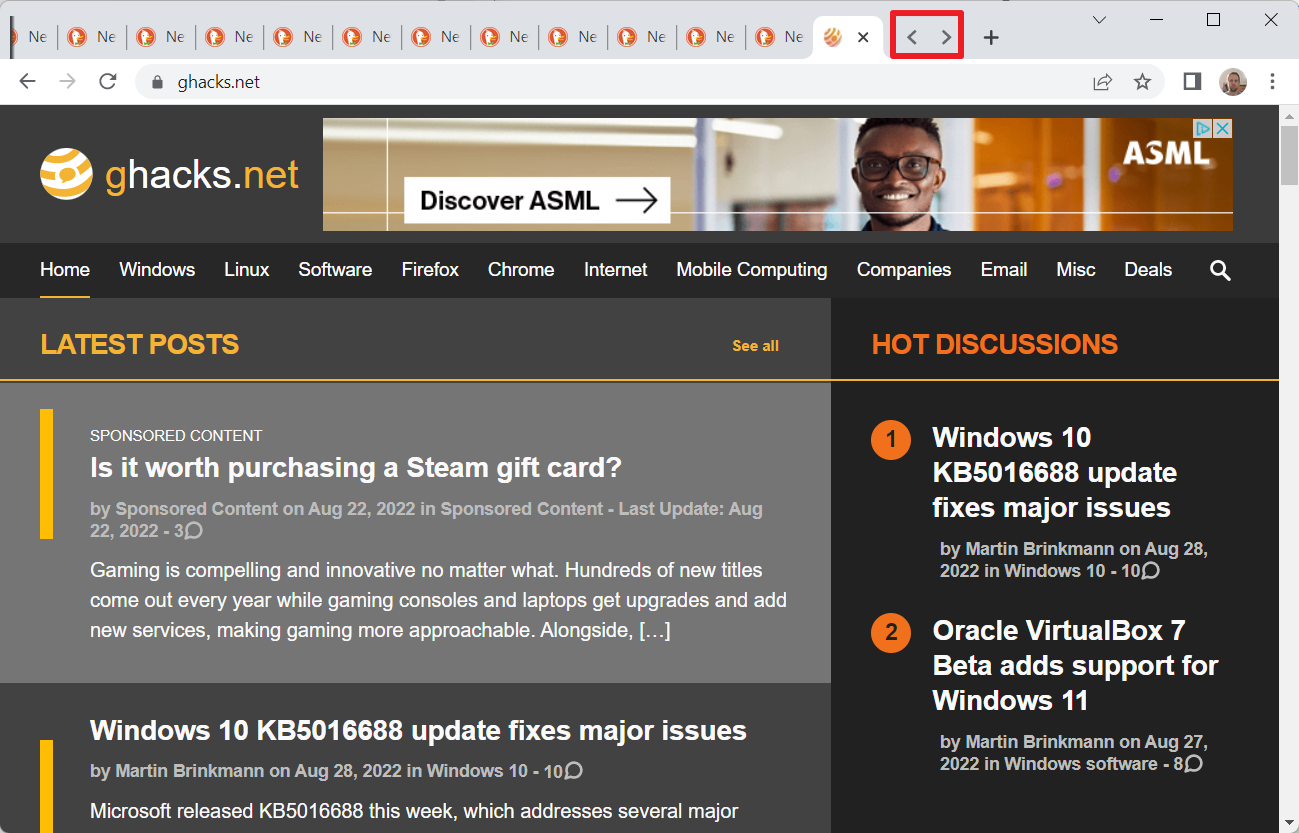
What if when no more tabs can be displayed at the minimum tab width, an arrow pointing right was displayed at the right end of the bar to indicate that more tabs exist?
Clicking the arrow could then scroll the tab array to the left to display the now hidden tabs, with the right arrow changing to a left arrow to indicate the presence of the left tabs now hidden, and enable return to the standard tab display…
Clear and intuitive?
I’m not sure if I am misunderstanding you Chris but that is also what is on offer within the experimental settings.
It’s worth noting that these features (and many more) have been available for over a decade on Firefox.
OK, I’ve found the tab scrolling flag from the link above in the article, I’ll give it a trial.
Not exactly what I envisaged, maybe there is a good reason for that, my suggestion was not for tab scrolling with the mouse but to shift the displayed tabs as a block to the left or right when an arrow at the appropriate end was displayed indicating that there were tabs that couldn’t be displayed.
The display of the arrow, or if necessary one at each end when there were a large number of open tabs, would serve as an indication that there were hidden tabs.
Thanks Mystique, when the idea came to me while reading the thread it seemed the ideal interface to manage working with many tabs open, as I like Martin frequently have.
If you think it may already be an option, could someone please give me a pointer to how to easily enable it?
I’ve been testing this feature since possibly last year. It’s something that should have been in the browser since day one. I have found no real negative issues with it and it should be moved out of experimental and into mainstream now. If people like the standard toothpick tabs then that is still possible. If people like having easily visible tabs, side scrolling tabs and a drop down tab list without having to install a rubbish addon then this is for you.
It’s taken them this long to get here and yet they are still dragging their knuckles on it as experimental. If anything they should be adding more features to the tab system.
This is all a consequence of Googles DUMB decision to stick its tabs in the Window Title bar.
Tabs aren’t what the title bar is for and Microsoft should have told Google to come up with another solution or it would break their tab implementation.
What? Thank God Chrome added them in the titlebar. It was the SMARTEST place to be and it was where people wanted them to be and that forced other browsers includng Microsoft’s IE to put them in the right place.
Your not very smart yourself, are you? So it is easy to understand why you think tabs in the title bar makes sense.
@Jojo
Shut up. Your are using an outdate and version of a browser for an outdate version of an add-on. You are not smart at all.
@Jojo
People want a browser to be convenient and the tabs in titlebar is convenient. They don’t want to feel smart they can find their tabs in weird places like you want. Find other ways to feel smart and special lmao.
Where are tabs supposed to be? Firefox’s tabs were below the address bar before Firefox 4 released and began walking the path of a Chrome copycat and it wasn’t really much different. Firefox’s tab behavior, as far as I remember, has always been the same – when there are too much tabs, the tabs don’t go below a certain width and then they become scrollable.
Whether they are in the title bar or below the address bar, it hardly changes anything. I’ve seen some people gushing over vertical tabs, but they take up even more screen space and I really don’t see the benefit in having them over horizontal ones.
I really don’t know what you’re on about tabs not supposed to be in the title bar and would like it if you elaborated a bit.
As for the feature in question, it is useless to me as I prefer how Chrome handles tabs over how Firefox does as I would like to see all my tabs at once even if they are as wide as their favicon. I’m guessing this feature is people who like Firefox’s tab handling better and want to have it in Chrome, otherwise I don’t see how that is superior to the default way Chrome handles tabs.
The title bar isn’t for tabs. It’s for info on the window and the close/minimize/restore controls.
Microsoft set Windows design standards and they should have enforced that by forbidding tabs in the title bar.
Putting tabs in the title bar restricts them to a single row and as this article shows, runs into problems when their are too many open.
One of the reasons I keep using old FF ESR is for Tab Mix Plus which allows me to have unlimited rows of tabs that I can minimize with a button click.
And don’t tell me how I should work or how many tabs I should keep open. That is none of your concern.