Link previews in Word for the web: how to turn them on and off

A link preview in Word for the web is a small card that opens when you click a hyperlink's text in a document. It shows the linked site's logo, the page title, the URL, an image and a short description, plus buttons to copy, edit or remove the link. The feature only works when "Enable optional connected experiences" is turned on under File > About > Privacy Settings.
This guide explains what the preview shows, how to turn it on or off, why it depends on a privacy setting, and how hyperlinks behave in the Word desktop apps, which do not show the same preview card. It applies to the browser version of Word that comes with every Microsoft account, not only to buyers of the one-time-purchase Office 2024 or Microsoft 365 subscribers.
What a link preview in Word for the web shows
A Word for the web link preview gives you a summary of the target page without leaving the document. According to Microsoft's announcement, the preview card for an external link contains:
- The logo of the linked website
- The title of the linked page
- The full URL
- An image taken from the linked page
- A short description of the page's contents
Previews also work for links to headings and bookmarks inside the same document, which helps in long reports or contracts where a link jumps to another section. The card includes quick actions to copy the link, edit it or remove it, so you can fix a wrong URL directly from the preview instead of opening the Insert Link dialog.
The preview opens on click, not on mouse hover. You click the link text, the card appears inside the document, and you then decide whether to open the page in a new browser tab or keep working. This is the main difference from chat apps and social networks, which usually generate a preview automatically as soon as a link is pasted.
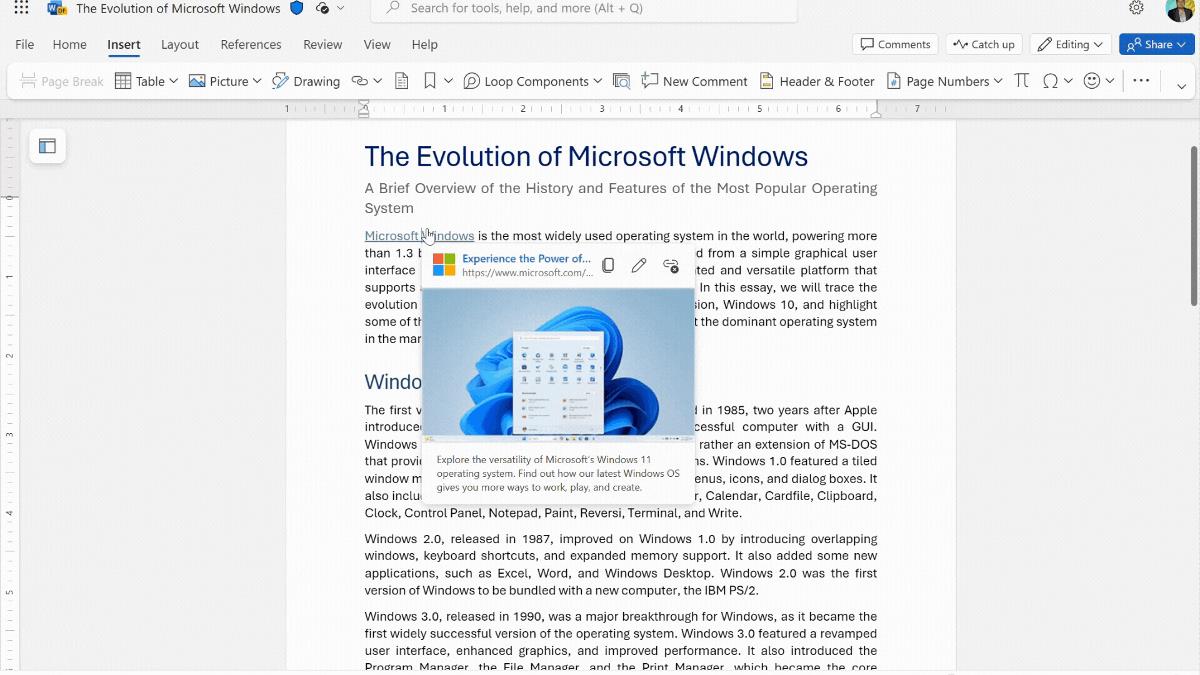
Image: Microsoft.
How to turn on link previews in Word for the web
Link previews in Word for the web turn on through the privacy setting for optional connected experiences. If the setting is off, clicking a link does not show the preview card. Follow these steps:
- Open Word for the web in your browser and sign in with your Microsoft account.
- Open any document.
- Select File > About > Privacy Settings.
- Check the box next to "Enable optional connected experiences".
- Close the dialog, then click the text of a hyperlink in the document to open the preview.
To turn link previews off, repeat the steps and clear the "Enable optional connected experiences" check box. Keep in mind that this switch controls a whole group of online features, not only link previews, so other optional features that rely on online services stop working as well.
If the setting is greyed out or missing on a work or school account, your organization's administrator controls it. Microsoft lets admins manage connected experiences with policy settings for Microsoft 365 Apps, so ask your IT department rather than looking for a workaround.
Why link previews depend on connected experiences
Link previews need connected experiences because Word has to fetch information from the linked website to build the card. The title, logo, image and description are not stored in your document; Microsoft's online services retrieve them from the target page when you click the link.
Microsoft groups features like this as optional connected experiences: online features that analyze your content or download online content. Its connected experiences overview explains that turning these off disables features such as Designer, Dictate, Translator and online templates and images, while required service data is still sent to Microsoft regardless of your choice. The list of optional connected experiences on Microsoft Learn shows the full scope, including link unfurling in Loop, which produces a similar preview card.
Whether the setting is on by default depends on your account and your organization's policies, so check it before assuming the feature is missing. If you work with confidential documents or links to internal pages, keeping the setting off means Word does not reach out to those sites to build a preview.
Hyperlink previews in Word for Windows and Mac
The preview card described above is a Word for the web feature; Microsoft's announcement does not list the desktop apps. In Word for Windows, hovering over a hyperlink shows a ScreenTip with the link address (or custom ScreenTip text set in the Insert Link dialog) and the hint to hold Ctrl and click to follow the link.
You can change that click behavior in Word for Windows:
- Select File > Options.
- Open the Advanced tab.
- Under Editing options, clear "Use CTRL + Click to follow hyperlink" if you want a plain click to open links, or keep it checked to avoid opening links by accident.
The privacy controls for the desktop apps sit under File > Account > Manage Settings, where you can switch optional connected experiences on or off for features that download online content.
FAQ
Why does clicking a link in Word for the web not show a preview?
The most common reason is that optional connected experiences are turned off. Check File > About > Privacy Settings, and if the option is locked on a work account, ask your administrator.
Can I see a link preview by hovering over a link?
No. In Word for the web you have to click the link text to open the preview card. Hovering does not open it.
Do link previews change the document for other readers?
No. The preview is generated on demand when someone clicks the link, and nothing is added to the file itself. Each reader sees previews only if their own privacy settings allow it.
How do I give feedback on link previews?
Microsoft asks for feedback through Help > Feedback in Word for the web.
Related: Office 2024 without a subscription, Word saving new documents to the cloud by default, restoring WordPad on Windows 11

batshit insane toxic idea.
100% NO GO feature.
Must have taken the wrong lessons from problems in the VBS embedding era. No longer a document in that case and certainly to be treated with tongs and inside a VM, isolated by multiple layers (proxies, firewalls etc).
Imagine all the things that can go wrong/be abused in browsers today. Now imagine that happening inside your word processor too, that has access to all your documents.
Because some BS about convenience? We can’t have “nice” features as long as software producers refuse to make SAFE software. Which btw includes the OS, drivers, bios/uefi and various firmware like on your hdd/ssd/nvme, NIC, GPU, the IME etc etc.
Last joke I heard was about bios splashcreen loaders being riddled with exploitable defects. We are in a world of shit but that is no valid excuse to introduce more risks.
In that case, you shouldn’t use social media because they sell your data and you shouldn’t be using AI stuff because none of that is properly regulated yet and who knows what they do with your input data. I mean, there’s issues everywhere. They’re actively trying to improve their services and products, but just because creating a new solution means that you’re opening up to more surface attacks, doesn’t mean you shouldn’t.