
Online Etymology Dictionary, Look-up Word Meanings, History

Etymology is the study of a word's meaning in history. If you are not a scientist trying to find the origin of a word and the changes it went through throughout history, you are probably most interested in the original meaning of a word. This can be interesting from two perspectives. You first may want to find out more about a word and its origins that you know little about. It can also be interesting if you are reading texts written in old English or other earlier forms of a language.
The Online Etymology Dictionary is available for free on the Internet. You can enter a word, or part of a word, a suffix for instance, that you are interested in in the form on the frontpage or start your search with a click on one of the letters of the alphabet.
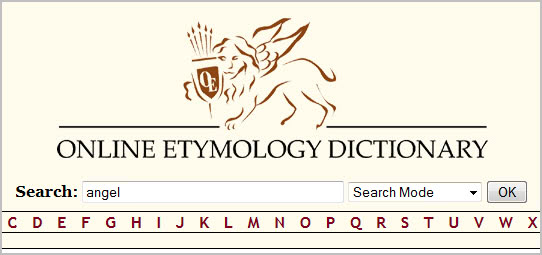
If you'd enter Etymology for instance you get the following information:
late 14c., ethimolegia "facts of the origin and development of a word," from O.Fr. et(h)imologie (14c., Mod.Fr. étymologie), from L. etymologia, from Gk. etymologia, properly "study of the true sense (of a word)," from etymon "true sense" (neut. of etymos "true, real, actual," related to eteos "true") + -logia "study of, a speaking of" (see -logy). In classical times, of meanings; later, of histories. Latinized by Cicero as veriloquium. As a branch of linguistic science, from 1640s. Related: Etymological; etymologically.
Information usually consists of one or multiple sentences. The related information are unfortunately not displayed as links, which means that you have to manually copy and paste them to perform a search on them.
One of the things that I like to do is to look up suffixes and prefixes, as they can help you get an understanding of a word even if you do know know what it means exactly. The suffix -itis for instance denotes diseases characterized by inflammation.
The etymology dictionary makes a handy bookmark for users who like to look-up word meanings and a word's history. Just head over to the site and start searching, and maybe share a word you discovered with the rest of us.
Advertisement












Did you forget to put this http://www.etymonline.com/ link into your articel?
Yes, thanks, and that’s the site.
“Christmas
late O.E. Cristes mæsse, from Christ (but retaining the original vowel sound) + mass (2). Written as one word from mid-14c. Father Christmas first attested in a carol attributed to Richard Smart, Rector of Plymtree (Devon) from 1435-77. Christmas tree in modern sense first attested 1835 in Amer.Eng., from Ger. Weihnachtsbaum. Christmas cards first designed 1843, popular by 1860s. Christmastide is from 1620s. Christmas Eve is M.E. Cristenmesse Even.”
SOURCE : .etymonline.com
—
Most interesting. Thanks :)