Optimizations for Windowed Games in Windows 11: On or Off?

Optimizations for windowed games is a Windows 11 graphics setting that switches DirectX 10 and DirectX 11 games running in windowed or borderless windowed mode from the old blt presentation model to the modern flip model. The result is lower frame latency plus support for Auto HDR and variable refresh rate (VRR). For most gamers it should be on. Turn it off only for a game that tears, stutters or crashes with it.
This guide explains what the setting does, when to leave it on or off, how to change it globally and per game, and how it differs from the older "fullscreen optimizations" checkbox.
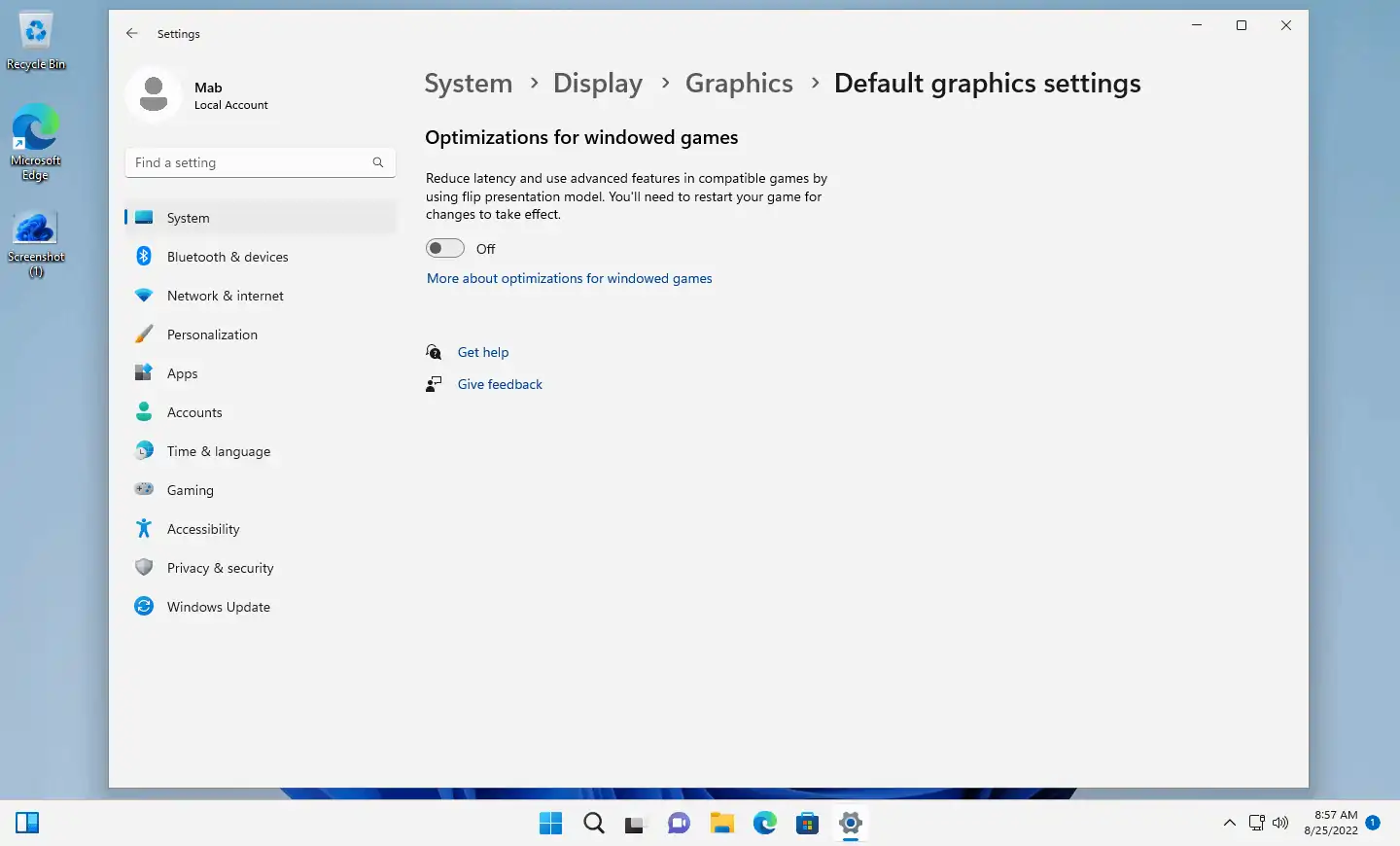
What are optimizations for windowed games?
Optimizations for windowed games is a presentation upgrade: Windows 11 takes a DirectX 10 or DirectX 11 game that runs in a window or borderless window and presents its frames with the flip model instead of the legacy blt (bit block transfer) model. Microsoft announced the feature on the DirectX Developer Blog in February 2022, and it shipped to everyone with the Windows 11 2022 Update (version 22H2).
With blt-model presentation, a game's frame is copied into the desktop compositor before it reaches the screen, which adds a step and latency. The flip model hands the frame over without that extra copy, which is the method DirectX 12 games already use. That is why DirectX 12 games are not affected by the setting: they use flip-model presentation by default.
Microsoft names three benefits across its support page for the feature and the DirectX blog announcement:
- Lower frame latency in windowed and borderless windowed DX10 and DX11 games.
- Auto HDR becomes available for those games on HDR-capable displays.
- Variable refresh rate works with those games on VRR (G-Sync or FreeSync class) monitors.
Exclusive fullscreen games are not affected, because the setting only changes how windowed presentation works.
Should optimizations for windowed games be on or off?
Optimizations for windowed games should be on for most players, especially on a VRR or HDR monitor and in games played in borderless windowed mode. The setting has no effect on DirectX 12, Vulkan-native or exclusive fullscreen titles, so turning it on costs nothing for those.
The one documented downside is screen tearing. Microsoft notes that at high frame rates, tearing can appear when the feature is on, and that tearing is still possible when a game exceeds the monitor's refresh rate. Microsoft's fixes, in order:
- Cap the game's frame rate at or slightly below the monitor's refresh rate.
- Enable V-Sync in the game.
- Use a VRR monitor, which removes most tearing inside the VRR range.
Use this quick decision table:
| Your situation | Recommendation |
|---|---|
| VRR or HDR monitor, DX10/DX11 games in borderless mode | Turn it on |
| You only play DX12 or exclusive fullscreen games | On or off makes no difference |
| One game tears, stutters or crashes after enabling it | Keep it on globally, turn it off for that game |
| Auto HDR is on | It stays on: Auto HDR requires it |
Microsoft also says it disables the optimization by default for apps with known issues, so not every game is switched over even when the global toggle is on.
How to turn on optimizations for windowed games in Windows 11
You turn optimizations for windowed games on or off globally in the Graphics page of the Settings app. The steps follow Microsoft's current support documentation:
- Press Windows-I, or select Start > Settings.
- Go to System > Display.
- Select Graphics.
- Under Default settings, turn the Optimizations for windowed games switch on or off.
- Restart any game that was running, because the change only applies on the next launch.
On older Windows 11 builds, the switch sat behind a "Change default graphics settings" link on the Graphics page. If you see that link, select it first, then use the switch.
If the switch is grayed out, Auto HDR is the reason. Microsoft states that turning on Auto HDR also turns on optimizations for windowed games, so you must turn off Auto HDR first before you can turn the optimization off.
For scripted setups, the setting is stored per user in the registry as the DirectXUserGlobalSettings string under HKEY_CURRENT_USER\Software\Microsoft\DirectX\UserGpuPreferences, with SwapEffectUpgradeEnable=1; for on and SwapEffectUpgradeEnable=0; for off. The Settings toggle is the safer route for everyone else.
How to turn off optimizations for windowed games for one game
You can turn off optimizations for windowed games for a single game while keeping it on for everything else, using the per-app options on the same Graphics page:
- Open Settings > System > Display > Graphics.
- Under Custom options for apps, select the game. If it is not listed, add it with the add app option (desktop app or Microsoft Store app) and point it to the game's executable.
- Select Options.
- Under Graphics preference, turn off Optimizations for windowed games. On some builds this appears as a "Don't use optimizations for windowed games" checkbox, which you tick instead.
- Select Save and restart the game.
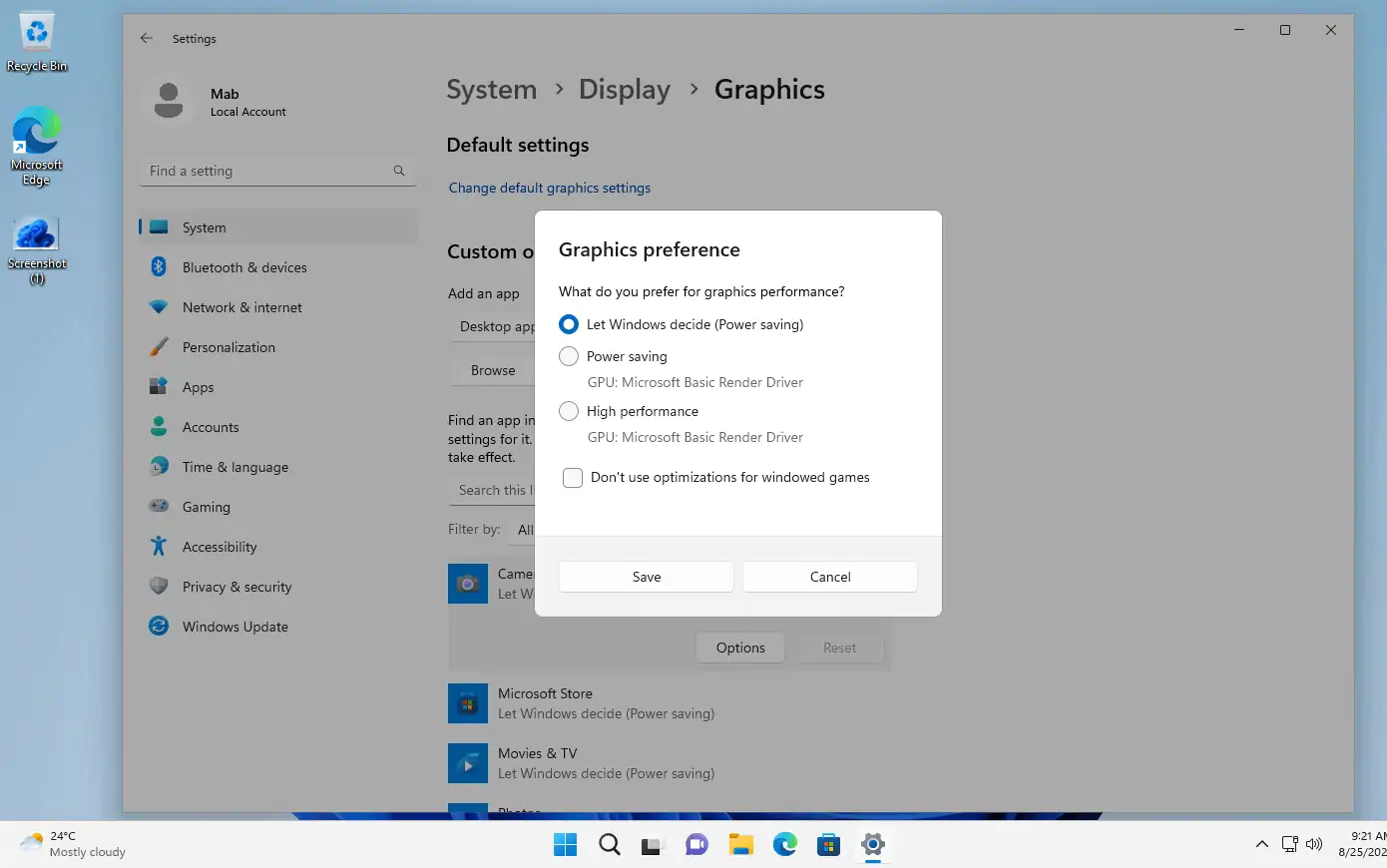
The same dialog sets the GPU preference for the game on systems with integrated and dedicated graphics, and lets you opt the game out of Auto HDR. Our guide to assigning graphics performance preferences to Windows 11 programs covers the GPU part in detail.
Optimizations for windowed games vs fullscreen optimizations
Optimizations for windowed games and fullscreen optimizations are two different Windows features, and confusing them is the most common mistake in game tuning guides.
| Attribute | Optimizations for windowed games | Fullscreen optimizations |
|---|---|---|
| What it changes | Upgrades windowed DX10/DX11 games to flip-model presentation | Lets Windows optimize games that take over the whole screen (on by default since Windows 10 version 1607) |
| Where you set it | Settings > System > Display > Graphics | Game .exe > Properties > Compatibility |
| Scope | Global switch plus per-app override | Per executable only |
Game publishers sometimes recommend ticking "Disable fullscreen optimizations" in the Compatibility tab to fix lag, as Riot Games does for League of Legends. That checkbox does not touch the windowed games setting, and vice versa. Change one at a time and test, so you know which change helped.
Does it improve gaming performance?
Optimizations for windowed games mainly improves latency and frame delivery, not average frames per second. The gain shows up as more responsive input and smoother pacing in borderless windowed games, plus working VRR and Auto HDR, rather than a higher FPS counter. Windows 11 overall performs much like Windows 10 in games, which is what our Windows 11 gaming benchmarks found, so treat this as a polish setting rather than a free performance boost.
To check the effect on your own system, play the same scene with the setting on and off, with an FPS and frame time overlay running. Windows 11 can show CPU, GPU and RAM usage natively. If a game still stutters after that, the cause is often elsewhere, for example memory pressure, which tools like Intelligent Standby List Cleaner target.
FAQ
Is optimizations for windowed games on by default?
It depends on the device. On many Windows 11 installations the switch starts off, while some systems ship with it on, and enabling Auto HDR turns it on automatically. Check Settings > System > Display > Graphics to see your current state.
Is optimizations for windowed games available in Windows 10?
No. Microsoft documents the setting for Windows 11 only; it arrived with the Windows 11 2022 Update (22H2).
Does it affect DirectX 12 games?
No. DirectX 12 games already use flip-model presentation, so the setting only changes DirectX 10 and DirectX 11 games in windowed or borderless windowed mode.
Why can't I turn optimizations for windowed games off?
Auto HDR requires the optimization, so the switch is locked on while Auto HDR is enabled. Turn off Auto HDR first, then turn off the optimization.
Related: Should you upgrade to Windows 11 for gaming?, DirectStorage and faster game loading

Sure, you’ve got Windows 10 but, what if you want to go higher?
See, this Windows goes to 11, that’s one more.
My PC is purpose built to play games and the last thing I want interfering with my GPU settings is the windows OS.
One way to enhance your gaming experience is to stay away from Windows 11. This operating system is barely alpha quality and terrible for doing anything than staring at your computer screen. I miss the day when Microsoft created fully functional operating systems before making them available to the general world.