How to change default apps in Windows 11 and Windows 10

To change default apps in Windows 11 or Windows 10, open Settings, select Apps, then Default apps. From there you can pick an app and choose which file types and link types it opens, search for a file extension such as .pdf or a link type such as mailto and assign an app to it, or set a default browser. The fastest route to that page is Win+R, then ms-settings:defaultapps.
This guide covers each method on Windows 11 and Windows 10, the Open with shortcut from File Explorer, how to reset all defaults, and the Control Panel route used on Windows 8.1.
Change default apps in Windows 11 Settings
Windows 11 handles default apps on one Settings page, Apps > Default apps, and offers three ways in: by app, by file type and by link type. Microsoft documents the same procedure in its Change default apps in Windows help article.
- Press Win+I to open Settings and select Apps, then Default apps.
- To change defaults for one program, search for or scroll to the app under the applications list and select it. Windows lists every file type and link type the app can open.
- Select a file type or link type, pick the app you want in the dialog, and confirm with Set default.
- To work by extension instead, type the extension (for example .txt) in the search box at the top of the page, select the result and choose an app.
- For a full list, use Choose defaults by file type or Choose defaults by link type near the bottom of the page.
The per-app view is the right tool when you install a new media player or editor and want it to take over some formats, but not all. VLC, for example, can open audio and video; you can assign it the video extensions and leave audio files with another player. If the app you want is missing from the dialog, use Choose an app on your PC to point Windows to its executable.
Set the default browser in Windows 11
The default browser in Windows 11 is set on the browser's own entry under Settings > Apps > Default apps, which has a Set default button at the top. Select your browser (Firefox, Chrome, Brave or another installed browser), then select Set default next to the line that offers to make it your default browser. A check mark confirms the change.
Microsoft changed this button on recent Windows 11 builds, starting with users in the EU: Set default can assign the browser to more of the web file and link types at once (such as .htm, .html, http and https), and the page can show a separate one-click option for .pdf files, so you decide whether the browser also opens PDF documents. Where the new behavior is active, Set default may also pin the browser to the taskbar and Start menu; clear those checkboxes if you do not want the pins. Depending on your build and region, the page may still show the older layout.
If a single file or link type still opens in the old browser afterwards, open the browser's entry on the Default apps page again and change that type manually. Browsers usually also offer a "make default" button in their own settings, which opens the same Settings page.
Change default apps in Windows 10
Windows 10 uses the same Settings path, Settings > Apps > Default apps, but the page is laid out differently. At the top it lists the main categories: email, maps, music player, photo viewer, video player and web browser. Select the app shown under a category and pick a replacement from the list.
Below the categories, three links give finer control:
- Choose default apps by file type: a list of every registered extension with the app that opens it.
- Choose default apps by protocol: link types such as mailto and http.
- Set defaults by app: select a program to see and change each file type it supports.
Windows 10 also has a Reset button on the Default apps page that returns every association to the Microsoft defaults.
Use Open with to set a default from File Explorer
The quickest way to change the default app for a single file type is the Open with dialog in File Explorer. It works the same way on Windows 11 and Windows 10 and does not require a visit to Settings.
- Right-click a file of the type you want to change.
- Select Open with, then Choose another app.
- Pick the app from the list. If it is not shown, scroll down for more apps or use Choose an app on your PC.
- On Windows 11, select Always to make it the default, or Just once to open the file without changing anything. On Windows 10, tick the Always use this app option before you select OK.
Use Just once when you want to try a program before committing. Newer Windows 11 builds may also show Microsoft Store suggestions in this dialog; they are marked with a Store icon, and you can ignore them if you already have the app installed.
Reset all default apps
Resetting default apps returns every file and link association to the defaults Microsoft ships with Windows. Use it when associations are broken after an uninstall or when too many types point to the wrong program.
On Windows 11, open Settings > Apps > Default apps, scroll to the bottom and select Reset next to Reset all default apps (some builds word it as a reset to the Microsoft recommended defaults). Confirm with OK; a check mark appears when it is done. On Windows 10 the Reset button is on the same Default apps page.
A reset cannot be undone. Note your custom defaults first (your browser, PDF reader, media player and image viewer are the usual ones) so you can set them again afterwards. If file icons still show the old program after a change, rebuilding the Windows icon cache usually fixes the display.
Set default programs in Windows 8.1 Control Panel
On Windows 8 and 8.1, default programs are set in the Default Programs Control Panel applet rather than in Settings. Press the Windows key, type default and select Default Programs. Windows 8.1 is no longer supported by Microsoft, but the applet works on machines that still run it.
The applet offers two main options. Set your default programs makes a program the default for every file type and protocol it can open. Select a program in the list, then choose Set this program as default to assign everything it supports, or Choose defaults for this program to pick specific file types.
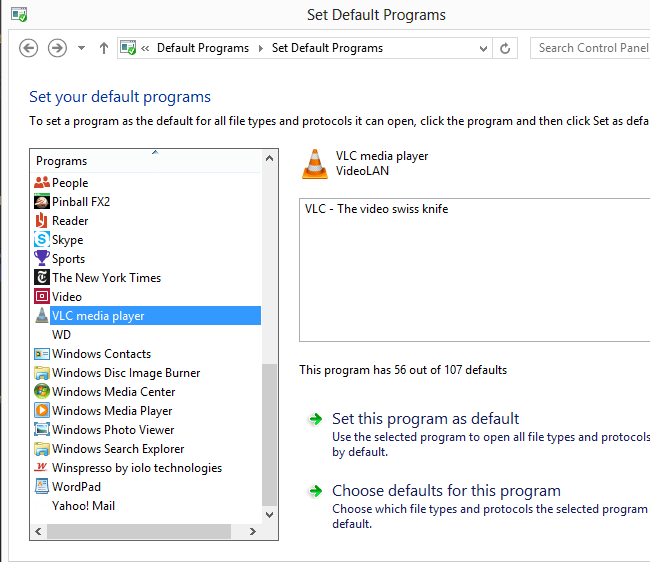
Choose defaults for this program opens a checklist of extensions and protocols. Check the ones the program should open and uncheck the rest, then save.

The second option, Associate a file type or protocol with a program, shows every known extension with its description and current default. Double-click an extension to open the "How do you want to open this type of file" dialog and pick a new program.

Which method should you use?
The right method depends on how many file types you want to change. Use this table to choose.
| Goal | Windows 11 and 10 | Windows 8.1 |
|---|---|---|
| One file type | Open with > Choose another app > Always | Associate a file type or protocol with a program |
| All types for one app | Default apps > select the app | Set your default programs |
| Default browser | Browser entry > Set default | Set your default programs |
| Undo everything | Reset on the Default apps page | Reassign manually |
FAQ
Why does Windows keep changing my default apps back?
Feature updates, app updates or an app that re-registers itself can reset an association. Set the default again on the Default apps page and check the app's own settings for an option that claims file types on startup.
How do I open the Default apps page directly?
Press Win+R, type ms-settings:defaultapps and press Enter. The same shortcut works on Windows 11 and Windows 10.
Can I make Windows Photo Viewer the default image app again?
Yes, once it is restored. Follow our guide to restore Windows Photo Viewer in Windows 11, then assign it to .jpg, .png and other image types via Open with or the Default apps page.
Related: How to restore the Photos Legacy app, how to bring WordPad back to Windows 11 and why Apps & Features does not replace Programs and Features.

In Windows 8, I am having problems changing the default e-mail program to Mozilla Thunderbird. As administrator I click on ‘Set program access and computer defaults’ and then click the down arrows associated with the Custom option. I then select Mozilla Thunderbird as the default e-mail program and click on Ok. When I go back to look ‘Use my current e-mail program’ is selected.
Is there a way to fix this?
Thanks,
Jim
Have you tried checking in Thunderbird itself? Tools > Options > Advanced > General
I am trying to reset inyternet explorer as my default browser not having any luck on the start it says app removed?
Is anyone else experiencing where the power icon is not being displayed in the Windows 8 operating system (OS). It is grayed and is defaulted to off (the user is unable to change)?
No, actually it doesn’t, smartass. Applications not installed from the Windows store can set themselves up as a default application as well. RTFA.
Never install files from the Windows Store. Problem solved.