How to track changes in PowerPoint
PowerPoint has no Track Changes switch like Word. To see what changed, use Show Changes (Review tab, Activity group) on a presentation stored in OneDrive or SharePoint, which highlights edits others made since you last opened it. Version History lets you open older copies, comments handle feedback, and Review > Compare merges two files in older versions, but Microsoft retired Compare in Microsoft 365 PowerPoint for Windows from version 2502.
This guide explains which method fits your setup, how each one works step by step, what PowerPoint does not record, and how to see who made a change.
Can you track changes in PowerPoint?
You cannot track changes in PowerPoint the way you do in Word, because PowerPoint has no mode that records every edit as a markup you accept or reject. Instead, Microsoft offers four tools that cover parts of the job:
- Show Changes: highlights slides and objects that co-authors edited since you last opened the file. Needs OneDrive or SharePoint.
- Revision highlighting: the turquoise or blue markers in the thumbnail pane that flag slides with unread changes, with the editor's name and time.
- Version History: opens earlier saved versions of a cloud file as read-only copies.
- Compare: merges a reviewed copy into the original and lists every difference in a Revisions pane. Only in older PowerPoint versions.
Comments sit alongside all four: reviewers can leave notes on slides, @mention colleagues (Microsoft 365) and resolve threads when they are done.
Which method should you use?
The right method depends on where the file is saved and which PowerPoint version you run. Cloud files edited in Microsoft 365 get Show Changes and Version History; files emailed back and forth as attachments need Compare, which only older builds still have.
| Situation | Best method | Limits |
|---|---|---|
| Co-authoring a file in OneDrive or SharePoint | Show Changes plus revision highlighting | Shows changes since your last visit, not a full log |
| Need an earlier state of the deck | Version History | Read-only; copy content back or save a copy |
| Two separate files (original and reviewed copy) | Review > Compare | Retired in Microsoft 365 for Windows from version 2502; not in Mac or web |
| Feedback without editing the slides | Comments and @mentions | Reviewers must write their changes as notes |
If your team still swaps files by email, the most reliable fix is to move the deck to OneDrive or SharePoint and share a link, so everyone edits one copy.
How to see changes in PowerPoint with Show Changes
Show Changes is the closest thing PowerPoint has to track changes: it highlights revisions other people made since you last opened the file. It works in PowerPoint for Microsoft 365 on Windows and Mac and in PowerPoint for the web, as long as the presentation is stored in OneDrive or SharePoint.
- Open the presentation from OneDrive or SharePoint.
- Select the Review tab.
- In the Activity group, select Show Changes.
- Look for the dot to the left of updated slides in the thumbnail pane.
- Open a flagged slide: revised objects are briefly outlined in color.
Opening a highlighted slide marks its changes as read, so the markers disappear once you have looked. That makes Show Changes good for catching up after colleagues edited the deck, but not for auditing a full edit history.
How to see who made changes in PowerPoint
PowerPoint shows who made a change through revision highlighting: when you open a slide with unread changes, the changed area is outlined and labeled with the editor's name and the time of the edit. Hover over a highlighted thumbnail to see the "Slide has unread changes" tooltip.
Several conditions apply, according to Microsoft's documentation:
- The file must be in OneDrive or SharePoint and must not be encrypted or password protected.
- Highlighting does not work on .odp, .ppt or .pps files, so save the deck as .pptx.
- The person editing must use PowerPoint for the web, PowerPoint for Microsoft 365 for Windows (Current Channel 1707 or later), or PowerPoint for Mac 16.11 or later.
- If the Trust Center privacy options are turned on, revision highlighting is off and no names are stored.
PowerPoint also does not flag every edit. Changes to speaker notes, deleted shapes, added comments and animation changes are not highlighted. If you need to know about those, check Version History or ask reviewers to leave a comment.
How to use Version History in PowerPoint
Version History lets you open any earlier saved version of a presentation stored in OneDrive or SharePoint, which is the best way to see what a deck looked like before someone changed it.
- Select the file name in the title bar.
- Select Version History (Windows) or Browse Version History (Mac and web).
- Pick a version in the list and select Open Version.
- The version opens read-only in a separate window. Copy what you need, or use Save A Copy to work on it separately.
Version History shows saved states, not individual edits, so compare the old and new windows side by side to spot differences. For text-heavy slides, pasting both versions into a diff tool such as Meld or a list comparison tool makes wording changes easy to find.
How to compare two PowerPoint presentations
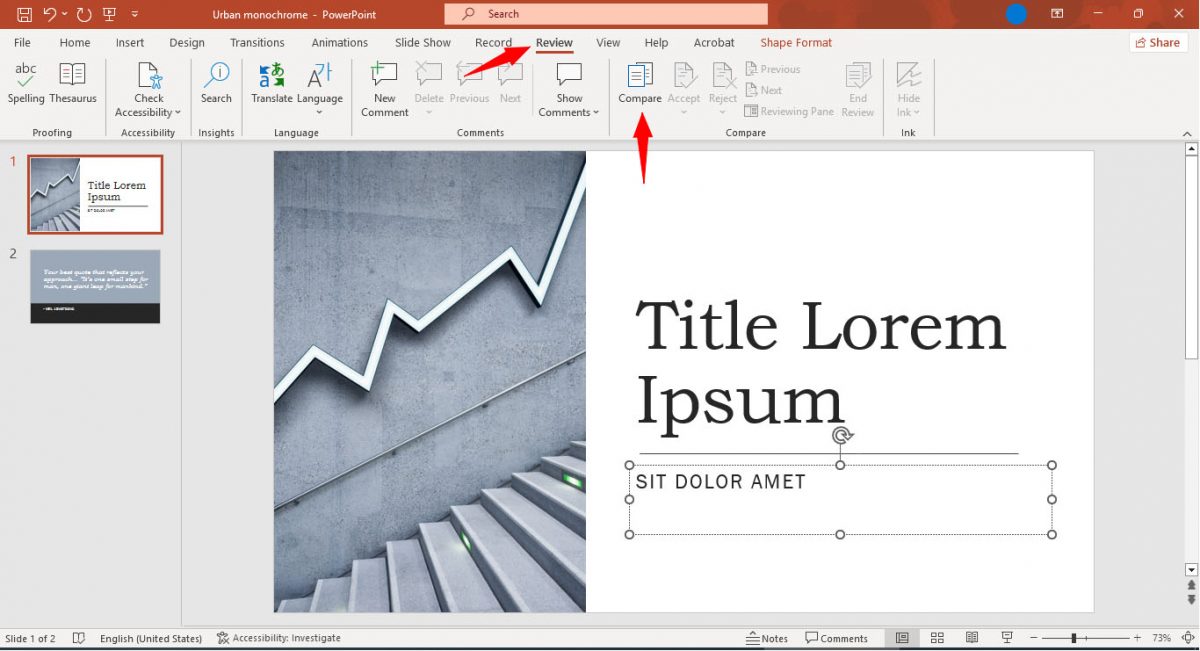
The Compare command merges a reviewed copy into your original and lists every difference, but Microsoft retired it in Microsoft 365 PowerPoint for Windows from version 2502; it remains in earlier versions, and Microsoft's Compare instructions still list PowerPoint 2016, 2019, 2021 and 2024. It is not available in Microsoft 365 PowerPoint for Mac or PowerPoint for the web. Microsoft recommends its real-time collaboration tools instead.
If your version still has it:
- Open the original presentation.
- Select Review > Compare, then Compare again.
- In Choose File to Merge with Current Presentation, select the reviewed copy and select Merge.
- The Revisions pane opens. Reviewer comments appear under Slide Changes, edits under Presentation Changes.
- Select an item to see the change on the slide. Check its box to accept it; leave it unchecked to reject it.
If you are weighing a one-time-purchase PowerPoint instead of Microsoft 365, our overview of Microsoft Office 2024 explains what that edition includes.
FAQ
Can I track changes in a PowerPoint file saved on my computer?
Not with Show Changes or Version History, which both need OneDrive or SharePoint. For local files, only the Compare command works, and only in versions that still include it.
Why is the Compare button missing in PowerPoint?
Microsoft retired Compare in Microsoft 365 PowerPoint for Windows from version 2502, and it was never available in Microsoft 365 PowerPoint for Mac or the web. Use Show Changes and Version History on a cloud copy instead.
Does PowerPoint track changes in speaker notes?
No. Revision highlighting ignores the notes pane, deleted shapes, comments and animation changes. Open an earlier version from Version History to check those.
Related: Word saving documents to the cloud by default, link previews in Word for the web

“Almost everyone has loved working with PowerPoint.”
Not everyone loves death by PowerPoint
Shaun, did you notice that you wrought this article on December 17 and you updated this article on December 14? And this is not the first time you do that. I mean flip the date you write something and make an improvement. I have looked this up in your other articles.
And the referral “How Can I Use Office For Free Without Downloading it?” is a relative good one.