Windows 10 Start Menu: Layout, Customization and the Start Process
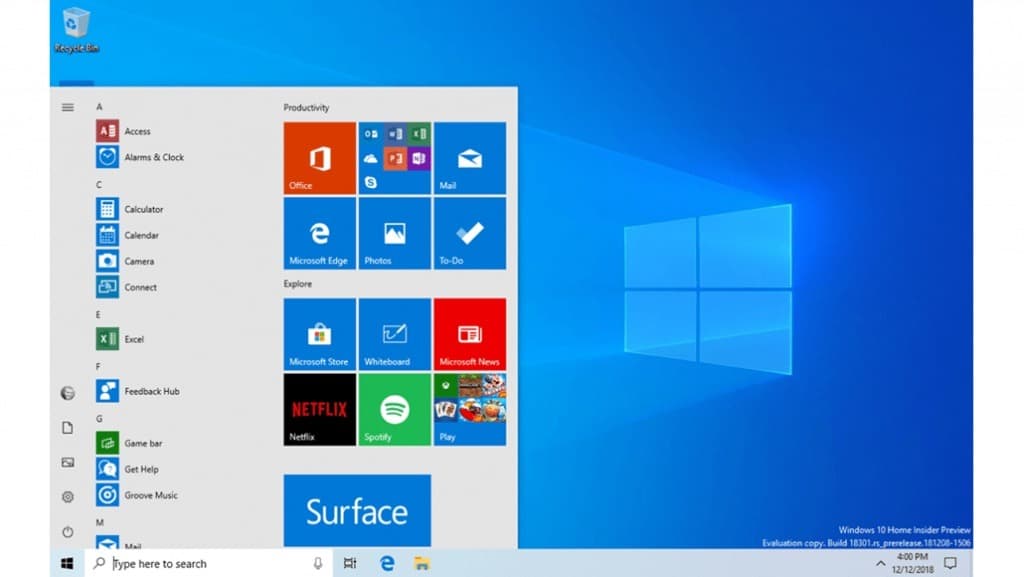
The Windows 10 Start menu opens with the Windows key or the Start button and has an alphabetical app list next to a narrow column with your account, folder shortcuts and power button, and a resizable area of pinned tiles on the right. You can pin apps, folders and websites, group tiles into groups and folders, and switch to full screen Start under Settings > Personalization > Start. Since the May 2019 Update, Start runs in its own process, StartMenuExperienceHost.exe.
This guide covers the default layout, every customization option Microsoft documents for Windows 10, the Start process and how to use it when Start stops responding, and what the end of Windows 10 support means for the Start menu.
Windows 10 Start menu layout
The Windows 10 Start menu layout combines a classic app list with Windows 8 style tiles. The left edge holds a narrow column with your account, shortcuts to folders such as Documents or Settings, and the power button. Next to it sits the app list, sorted alphabetically with recently added and most used apps at the top. The right side holds pinned tiles, which can be live tiles that show updated content such as weather or mail.
The May 2019 Update (version 1903) changed the defaults for new installations: Start uses a simpler single-column tile layout instead of the older two-column layout with many preinstalled tiles. Existing installations kept their layout. The same update added an "Unpin group from Start" option to the right-click menu of a group title, so you can remove a whole tile group, for example the default Productivity or Explore groups, in one step. It also made more preinstalled apps removable through Settings.
Useful keyboard entry points:
- Windows key or Ctrl+Esc: open or close Start.
- Windows key, then type: search apps, settings and files straight away.
- Windows+X or right-click on Start: open the Quick Link menu with Task Manager, Settings, Device Manager and shutdown options.
How to customize the Windows 10 Start menu
You customize the Windows 10 Start menu with right-click menus, drag and drop, and the Start page in Settings. These are the options Microsoft documents for Windows 10:
- Pin an app: search for it in the taskbar search box, right-click the result and select Pin to Start.
- Pin a folder: right-click the folder in File Explorer and select Pin to Start.
- Pin a website: open it in Microsoft Edge, open the menu and select More tools > Pin to Start.
- Unpin: right-click a tile and select Unpin from Start.
- Rearrange: drag a tile to a new position. Drag one tile onto another to create a tile folder, which you can rename; move all tiles out to delete it.
- Resize Start: move the cursor to the top or side edge of the open menu until it turns into a double-headed arrow, then drag.
The Start page in Settings (Settings > Personalization > Start, or type ms-settings:personalization-start in the Run box) holds the switches for the rest:
- Use Start full screen: Start fills the screen, similar to Windows 8.
- Show app list in Start menu: turn it off for a tiles-only Start.
- Choose which folders appear on Start: add Downloads, Documents, Pictures, Settings and other shortcuts to the left column above the power button.
The same page has switches for recently added apps, most used apps and suggestions. Turning off suggestions removes the app recommendations Microsoft shows in the app list.
The StartMenuExperienceHost.exe process
StartMenuExperienceHost.exe is the process that runs the Windows 10 Start menu. Microsoft split Start out of Explorer in the 19H1 preview builds (build 18317, January 2019) and shipped the change with the May 2019 Update. Before that, Start was hosted by ShellExperienceHost.exe together with other shell surfaces, so a problem in that shared process could slow or freeze Start. Giving Start its own process isolates it, which Microsoft presented as a reliability improvement, and it also lets you restart Start on its own.
To find the process, press Ctrl+Shift+Esc to open Task Manager, select More details if you see the compact view, and switch to the Details tab.
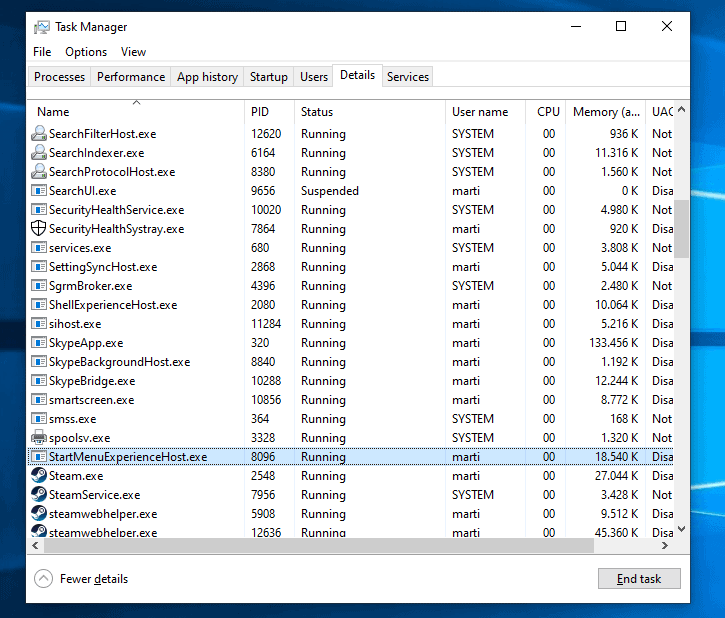
The legitimate file is loaded from C:\Windows\SystemApps\Microsoft.Windows.StartMenuExperienceHost_cw5n1h2txyewy. A process with this name running from any other location is not the Windows component and should be checked with your antivirus. To confirm the location, right-click the process on the Details tab and select Open file location.
What to do when the Windows 10 Start menu does not open
When the Windows 10 Start menu does not open or freezes, restart the Start process first, because that clears most hangs without a reboot. Work through these steps in order:
- Open Task Manager with Ctrl+Shift+Esc (it works even when Start is stuck).
- On the Details tab, right-click StartMenuExperienceHost.exe and select End task, then open Start again.
- If the taskbar is also unresponsive, find Windows Explorer on the Processes tab, right-click it and select Restart.
- Sign out and back in, or restart the PC.
- Install pending updates under Settings > Update & Security > Windows Update.
- Repair system files: open Command Prompt as administrator from Task Manager (File > Run new task, type cmd, check "Create this task with administrative privileges") and run sfc /scannow.
If a third-party Start replacement or shell tweak is installed, disable it before you troubleshoot, since these tools hook into the same components.
Windows 10 Start menu after end of support
Windows 10 support ended on October 14, 2025, so the Start menu will not get new features. According to Microsoft's end of support page, consumer PCs enrolled in Extended Security Updates (ESU) receive security updates through October 12, 2027. Enrollment is free when you sync your PC settings, costs 1,000 Microsoft Rewards points, or is a one-time purchase of $30 USD plus tax.
If you move to Windows 11, expect a different Start: it uses pinned icons and an All apps view instead of live tiles, and it is centered by default. Our guide on making the Windows 11 Start menu look classic shows how to bring back a more familiar layout, and the Windows 11 Installation Assistant guide walks through the upgrade.
FAQ
Can I open several Start menu apps at once in Windows 10?
Windows 10 Start does not support selecting multiple tiles, unlike Windows 8. There is a workaround to open multiple Start menu apps in one operation.
Is it safe to end StartMenuExperienceHost.exe?
Ending it closes the Start menu interface only, not your open apps or files. Open Start again afterwards; if it stays unresponsive, sign out or restart the PC.
Where are Windows 10 Start menu shortcuts stored?
The app list is built from shortcuts in C:\ProgramData\Microsoft\Windows\Start Menu\Programs (all users) and %AppData%\Microsoft\Windows\Start Menu\Programs (your account). Add or delete shortcuts there to change the app list.
Related: where Windows 10 stores desktop wallpapers, using the Windows 11 Media Creation Tool

Hi Martin, actually the MS folks disagree with your statement “It is not a legitimate process if the file resides in any other location on the device.” I have 4 iterations of the file named (note all lower case) “startmenuexperiencehost.exe” and 4 iterations of the file named (note components Capitalized) “StartMenuExperienceHost.exe”. The Windows “expert” stated “What are the other locations? If they are in the SxS folder or other system directory folders they are of no consequence,” so please tell me what is YOUR take on his statement, and on the following the following?
C:\Windows\servicing\LCU\Package_for_RollupFix~31bf3856ad364e35~amd64~~18362.900.1.8\amd64_microsoft-windows-s..riencehost.appxmain_31bf3856ad364e35_10.0.18362.752_none_510621314406b6d4\f\startmenuexperiencehost.exe
C:\Windows\servicing\LCU\Package_for_RollupFix~31bf3856ad364e35~amd64~~18362.900.1.8\amd64_microsoft-windows-s..riencehost.appxmain_31bf3856ad364e35_10.0.18362.752_none_510621314406b6d4\r\startmenuexperiencehost.exe
C:\Windows\servicing\LCU\Package_for_RollupFix~31bf3856ad364e35~amd64~~18362.959.1.9\amd64_microsoft-windows-s..riencehost.appxmain_31bf3856ad364e35_10.0.18362.752_none_510621314406b6d4\f\startmenuexperiencehost.exe
C:\Windows\servicing\LCU\Package_for_RollupFix~31bf3856ad364e35~amd64~~18362.959.1.9\amd64_microsoft-windows-s..riencehost.appxmain_31bf3856ad364e35_10.0.18362.752_none_510621314406b6d4\r\startmenuexperiencehost.exe
C:\Windows\SystemApps\Microsoft.Windows.StartMenuExperienceHost_cw5n1h2txyewy\StartMenuExperienceHost.exe
C:\Windows\WinSxS\amd64_microsoft-windows-s..riencehost.appxmain_31bf3856ad364e35_10.0.18362.752_none_510621314406b6d4\f\StartMenuExperienceHost.exe
C:\Windows\WinSxS\amd64_microsoft-windows-s..riencehost.appxmain_31bf3856ad364e35_10.0.18362.752_none_510621314406b6d4\r\StartMenuExperienceHost.exe
C:\Windows\WinSxS\amd64_microsoft-windows-s..riencehost.appxmain_31bf3856ad364e35_10.0.18362.752_none_510621314406b6d4\StartMenuExperienceHost.exe
[END]
Start menu process consume 18mb of ram!! It’s insane! Every update takes more and more ram.
Edit: my fault, it takes 24MB not 18. 24MB of ram! It a lot of ram if you ask me.
I think Windows XP system can operate at 24mb ram.
I refrain from most updates but was updated last night. I’m noticing a large memory usage and troubleshooting next how to end this task! I don’t need any new ‘experiences’ on my lap top, just more control. TYVM.
Is there a way to backport startmenuexperiencehost.exe to older versions of Win10? I’m on 1703 (last one with good task view imo). Wondering if just running the EXE would give me the new features.
XP was good, Windows 7 was okay, and Windows 10 is crippled.
Shouldn’t that trend be the other way around?
As for this start menu process, is that the same function connected with that modern looking GUI used for the settings and such?
If so, it sucks, as I’ve had it freeze where I’m left with a blank screen where nothing works.
Yup, bring back Explorer without that other GUI crap.
I think this is nice and they should have done this long time ago. Windows won’t end up to a black screen anymore when you restart explorer.
@Jeffrey,
I’ve never had this happen to me since the day my parents bought me my first computer in 2005 that ran Windows XP. Since then I’ve used every version of Windows, fiddled a lot with each version, managed to break it to the point of reinstall, but I’ve never had a “black screen” when I restarted explorer.exe.
Is that on Crapdows 10 that’s happening to you? Crapdows 10 is really poorly made, I feel like they’ve added new code on top of legacy code, because the Start Menu and Taskbar are not what they used to be before. And that could explain the anomalies you’re experiencing.
the joys of microsoft
I don’t know how anyone can use that nonsense. Its been 4 years and its still worthless. Any alternative is more efficient.
LOL!! I can’t wait when the cursor gets it’s own process… hell, even a separate process for each different cursor… xD
What a bunch of bull.
That would actually be pretty awesome if they could isolate user input into its own separate process that stays afloat no matter what happens to the system.
Maybe they will give us a proper way to add custom shortcuts to the start menu next. The current way is usually broken as the start menu only bothers to add shortcuts if the operating system thinks an install was run.
Start Menu is already NOT part of explorer.exe in Server 2016 :imgur.com/EJBk1Us
To anyone worrying, I doubt this will break programs like Classic Shell, StartIsBack, or similar.
Does that mean they’ve fixed the audio service issues plaguing the start menu issues in server 2016 from the March CU.
I hope that this won’t break Start10 too badly.
Start menu ? What start menu ? The last real start menu was in Windows 7 ! (Still i prefer XP’s menu)
This still won’t get me using that crappy Windows 10 start menu. No improvement productivity wise. Its design around touchscreen. I will continue using a proper start menus like Startisback and ClassicShell. Those are more suitable for mouse and keyboard.
I stopped keeping track of their Start menu of the year ever since Classic Shell arrived in 2009
Will this change bork Start Menu replacements like Classic Start Menu or Start10?
Wow, they must have hired someone really smart to make this change.
30+ years experience in OS development finally shows results.
Eating CPU not doing shit
fool me once. im not giving it another chance. open shell menu, start10, etc is proper software.