The new Task Manager in Windows 11: what changed and how to use it

The new Task Manager is the redesigned Task Manager that Microsoft shipped with the Windows 11 2022 Update (version 22H2). It replaces the old tab strip with a collapsible navigation pane, adds a command bar with common actions on every page, follows the Windows light or dark theme, and introduces Efficiency mode for throttling resource-hungry processes. Any supported Windows 11 PC already has it: press Ctrl+Shift+Esc to open it.
This page explains what changed compared to the classic Task Manager, how to get and open the new version, how Efficiency mode works, and why CPU figures in the Processes tab changed in 2025.
What is new in the Windows 11 Task Manager?
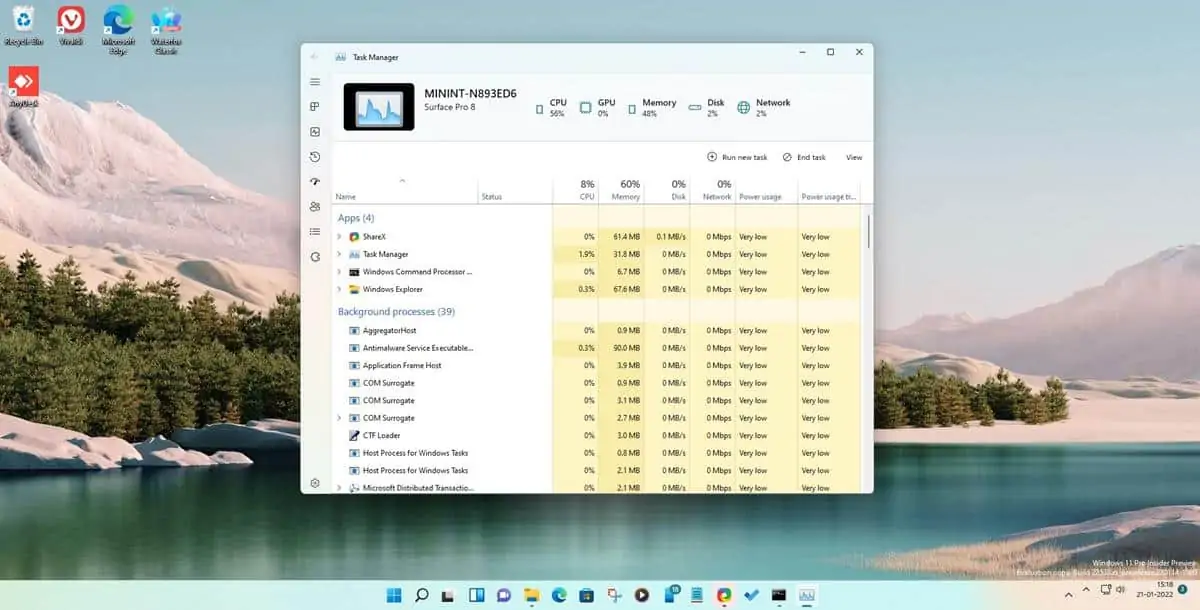
The new Windows 11 Task Manager keeps every tool of the classic version but reorganizes it around Windows 11 design principles. Microsoft's own summary for the first public test build was a "new hamburger style navigation bar and a new settings page", plus "a new command bar on each page" for common actions. The main changes are:
- A left navigation pane with Processes, Performance, App history, Startup apps, Users, Details and Services, collapsible with the hamburger button.
- A command bar at the top of each page, for example End task, Run new task and Efficiency mode on Processes, or start, stop and restart on Services.
- A Settings page at the bottom of the pane that replaces the old Options menu.
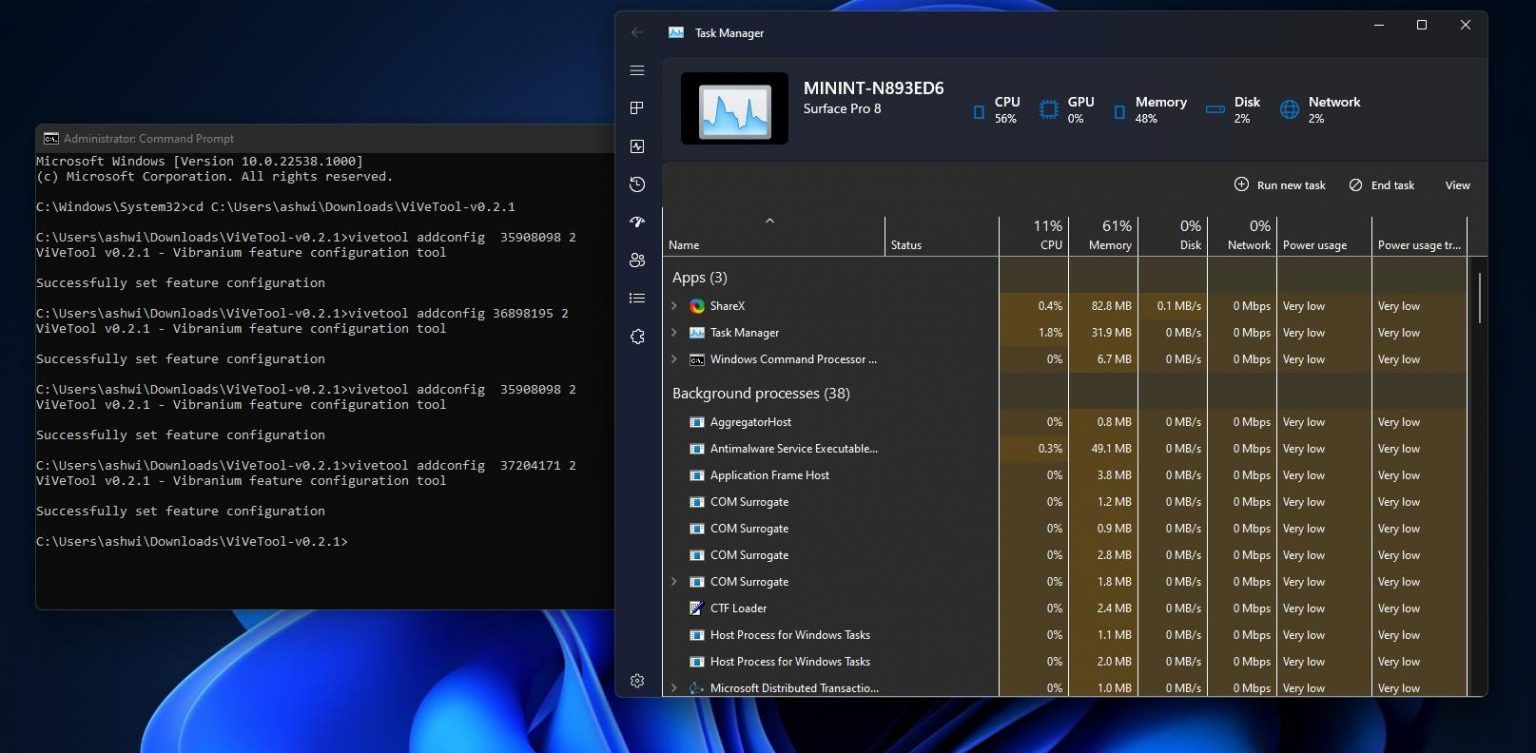
- Dark theme support that matches the theme set in the Windows Settings app.
- Efficiency mode, marked with a leaf icon, and a pause icon for suspended processes.
- Heatmap colors that follow the system accent color.
The compact "Fewer details" view of older versions is gone; Task Manager always opens in the full view.

New Task Manager vs classic Task Manager
The new Task Manager differs from the classic one mainly in layout and controls, not in the data it shows. The table compares the two.
| Feature | Classic Task Manager (Windows 10, Windows 11 21H2) | New Task Manager (Windows 11 22H2 and later) |
|---|---|---|
| Navigation | Tabs across the top | Collapsible navigation pane on the left |
| Actions | Buttons at the bottom and menu bar | Command bar at the top of each page |
| Options | File, Options and View menus | Dedicated Settings page |
| Dark theme | No | Yes, follows the Windows theme |
| Process throttling | Not available | Efficiency mode |
| Startup tab name | Startup | Startup apps |
If you only need to control what launches with Windows, the Startup apps page is where you enable or disable those entries.
How to get and open the new Task Manager
You get the new Task Manager by running Windows 11 version 22H2 or any later version; there is nothing to download or enable. Check your version first, then open the tool.
- Press Windows+R, type winver and press Enter. The dialog shows your Windows 11 version.
- If it shows 21H2, open Settings > Windows Update and install the latest feature update, or use the Windows 11 Installation Assistant.
- Press Ctrl+Shift+Esc to open Task Manager directly, or right-click the Start button and select Task Manager.
- Click the hamburger icon at the top left to expand or collapse the page names.
The new layout also brought keyboard shortcuts for the command bar: Alt+E ends the selected process, Alt+N opens Run new task, Alt+V toggles Efficiency mode, and Ctrl+Tab or Ctrl+Shift+Tab cycles through the pages.
Version 22H2 added a few more that Task Manager does not advertise: pressing Alt on its own toggles the shortcut letter highlights, Alt+M manages user accounts on the Users page, and Alt+O opens the Services app from the Services page. Some shortcuts only work when the matching page or item is selected.
How to use Efficiency mode in Task Manager
Efficiency mode is a Task Manager feature that lowers the priority of a process so Windows gives other apps precedence, which Microsoft says improves foreground responsiveness and energy efficiency. It is useful when one app is consuming a lot of resources but you do not want to close it.
- Open Task Manager and go to Processes.
- Expand the app group and select the individual process.
- Click Efficiency mode in the command bar, or right-click the process and select Efficiency mode. Confirm the prompt.
A leaf icon in the Status column marks processes running in Efficiency mode. Two rules apply, according to Microsoft's announcement: you can apply it to a single process, not a whole process group, and the option is greyed out for core Windows processes because throttling them could affect system performance. For finer, persistent control over priorities and CPU affinity, a dedicated tool such as Process Lasso goes further than Task Manager.
On the Details page, Efficiency mode is only available from the right-click menu, not the command bar. In version 22H2 the setting also did not stick: a process ran in Efficiency mode only until it was closed or Windows restarted, and was back to normal on its next start.
Why CPU usage in the Processes tab changed
Task Manager now uses the same CPU formula on the Processes, Performance and Users pages, so the numbers match each other and third-party monitoring tools. Microsoft announced the change in Insider build 27808, saying Task Manager "will now use the standard metrics to display CPU workload consistently across all pages", and it reached Windows 11 24H2 with the optional KB5064081 update in August 2025.
Previously, the Processes page used a Processor Utility metric that compared load to the processor's base clock speed, so a busy process could show different values there than on the Performance page. If you prefer the old figure, open the Details page, right-click a column header, choose Select columns and enable the CPU Utility column, which is hidden by default and shows the previous Processes value.
Task Manager settings explained
The Settings page of the new Task Manager collects the options that used to live in the menu bar. The main options are:
- Default start page: choose which page opens when you launch Task Manager, for example Performance instead of Processes.
- Real time update speed: set how often the data refreshes, or pause updates.
- Window management: options such as keeping Task Manager always on top and minimizing it on use.
Theme handling follows the Windows setting, so switching Windows to dark mode under Settings > Personalization > Colors switches Task Manager too.
Heatmap colors follow the accent color you set manually or automatically under Settings > Personalization > Colors. In the 22H2 release, Windows fell back to blue in some cases to keep the heatmap readable, and picking a manual accent color usually fixed that.
The old menu bar was split up in 22H2. Exit was dropped (close the window or press Alt+F4), Run new task moved to the command bar, and the View menu survives on the Processes page with only Group by type, Expand all and Collapse all; Refresh now is gone. Settings also holds Hide when minimized, Show full account name and Show history for all processes.
How the new Task Manager started
The redesign first surfaced as a hidden feature in Windows 11 Insider Preview Build 22538 in January 2022, when testers enabled it with the open-source ViVeTool. Microsoft introduced it officially in Dev Channel build 22557 in February 2022 and shipped it to everyone with version 22H2. The ViVeTool commands from that period are no longer needed or relevant on current Windows 11 builds.

FAQ
Can I get the old Task Manager back in Windows 11?
Microsoft offers no setting to switch back to the classic Task Manager in Windows 11 22H2 and later. All classic functions are still available in the new layout.
Is the new Task Manager available on Windows 10?
No. The redesigned Task Manager is part of Windows 11 version 22H2 and later; Windows 10 keeps the classic version.
Does the new Task Manager use Mica?
Yes. The version that shipped with 22H2 uses the Mica backdrop, rounded corners and new icons, so desktop colors show subtly through the window frame.
Related: Security Task Manager review, change Windows 11 to a classic look, rebuild the icon cache in Windows 11

in PowerShell or Terminal you have to prefix the commands with .\
or you’ll get this error:
vivetool : The term ‘vivetool’ is not recognized as the name of a cmdlet, function, script file, or operable program.
…
Ah Microsoft is up to its old tricks. The interface is so reminiscent of that of the Vivaldi Browser, especially in the compact icon-only mode. And it’s available in Edge, as well, with the expanding from icon when you hover modality, too.
Hooray for Vivaldi, Microsoft considers you enough of a threat to copy your design language.
Another part of Windows ruined. Hopefully Startisallback can undo this nonsense.
Now Task Manager will be bloated, slow, and fail to open like every other part of Windows they ruined with this horrible looking interface. Why do we need hamburger menus on a desktop OS? The tabs on the old one was perfectly fine; it didn’t waste ton of space.
I’d love to see someone create a better take on the Task Manager prior to Windows 10 upwards rather utilizing their own design concepts based upon the old task manager or System Explorer but that is pretty relevant to windows as a whole. The sad thing is that it just gets worse and worse.
It almost makes one long for Longhorn.
I still believe System Explorer was and is a vastly superior task manager to whatever Microsoft has come up with. It is abandonware now but still seems to work. I wish the developer stuck with it though.
This is exactly my thoughts. Not limited to the task manager of Microsoft.
Agreed! A lot of other task managers just don’t seem to come close IMHO. Yes I am aware of process hacker and process explorer but I am just more content using System Explorer. Too bad the developers never even released the source for it before they left.
I tried contacting them a few years ago but their email address also appears to be dead too.
feel like they’re trying to ripoff look from the new kde sys monitor.
There have at least 40 feedback mentions on the Insider Feedback Hub that Task Manager manager crashes when the performance tab is clicked in build 22538.
With this new interface, Task Manager still crashes on my computer with build 22538 when I click the performance tab.
Download the appropriate graphics card driver, which graphics card do you have? Also check the Ethernet driver …
I have a GeForce GTX 1660 Super with the latest driver, 511.23 – Release Date: Fri Jan 14, 2022.
Martin, you couldn’t be bothered show the Performance tab in dark mode? >__> Everyone who hates being blinded has been complaining about this for years.
MaArtin, you couldn’t be bothered show the Performance tab in dark mode? >__> Everyone who hates being blinded has been complaining about this for years.
Dark mode is the worst option for the eyes ever. My aunt works at optics services and she said that dark mode increases vision problems, eyestrain and myopia, as dozens of people confirmed tha abuse of the dark mode in their computers and smartphones. The best behaviour in her opinion is using the night mode of W10/W11 (to clear the blue light of the screen) or even glasses to reduce blue light. However dark mode should be only restricted to save battery in certain circumstances. :]
Your aunts opinion might have some truth in it. On the other end, my eyes actually hurt when trying to read black texts, bathed in pools of bright white light.
As always, it depends. How is the surrounding lighting solution? This has a more profound influence on how you are able to read text on different backgrounds. Not all color combinations being used with dark backgrounds are good. But some color combinations work surprisingly well.
Remember the days of your computer only having a 2 color video output on a 2 color screen? And that one of those colors was always black? The colors then weren’t the bad thing, staring into a CRT the whole day was.
Those colors were usually something resembling black (but not pure black) and a more pastel white instead of pure white. That didn’t cause nearly as much eyestrain as people make it out to be today as those colors were not chosen randomly.
It is my opinion that people watch too many computer screens of very varying sizes for far too long and that this is the actual cause of myopia, eyestrain etc.
Sure, that is not what you want to hear and probably don’t even believe. But if you feel your eyes starting to become uncomfortable to use, stop watching at a screen and go for around 30 minutes into your garden, or park, or anything else that doesn’t involve looking at any screen. You will notice very quickly that your eyes feel a lot better. And that over time your eyesight will improve somewhat.
I notice this myself, as a guy close to 50 and using helper glasses to watch computer screens for work. I just go and do something else completely for about 30 minutes or so. Not only does that give me ideas, those helper glasses are now used about 50% of the time. The rest of the time I can actually read/watch screens again without them.
Still, my opinion is about as valuable as your aunt’s opinion in these matters. I know what I have noted myself on my person. It won’t be true for everyone, but staring less at so many different screens will improve your life and you’ll get a stay of execution on any eye-sight problems you may have developed by staring at so many screens the whole day.
@Gerold Manders if you can, just try the “read mode” of Windows, it’s a good protection that should be enabled by default. You can adjust it to 50% as my father does. My father also always reads computer screens with glasses to reduce the blue light, and he has by now no complaint about his new work glasses. They were recommended by my aunt and the cost is not as expensive as I expected to be. Furthermore the higher problems of light screens are not from the light itself but the unnatural “blue” light that forces the eye too much. The more you read dark mode screen the more your eye will be unable to read light mode screens. Anyway, thanks for you opinion, it has some good points that I will speak with my aunt. :]
@John G
To be fair the ones using dark mode are using it in dark environment so it’s not the mode itself that cause vision problems.
There’s nothing like ‘blinded by task manager’ if they view it in well-lit environment.
@Anonymous some users live in darkness. I love vampire stories so much! :]
This exactly. Dark More is purportedly effective only on handheld devices with AMOLED screens since on AMOLED the true black color is achieved by completely turning off the backlight for the relevant pixels. But on PCs where saving power is not a factor dark mode is just something people use to give their PCs a dark terminal look for that hacker feel. Not only it causes eyestrain but also makes most icons which are typically designed for normal white mode really dim and fuzzy.
I think it’s a good advance, while waiting for the mica effect. Thanks @Ashwin! :]
That’s literally just the Win32 TaskManager inside a useless UWP frame/container. Wasted space, consumes more resources, especially memory and has an annoying splash screen which has no place on a fast machine which is capable of opening everything instantaneously. How lazy is this.
Sysinternals’ Process Explorer or Process Hacker.
I personally use Process Hacker nightly (https://processhacker.sourceforge.io/nightly.php).
I use SystemExplorer and ProcessHacker for more advanced view.
System Explorer is more user friendly for causal task and at the same time is very powerful: https://systemexplorer.net