How to rebuild the icon cache in Windows 11

To rebuild the icon cache in Windows 11, open Terminal or Command Prompt and run ie4uinit.exe -show. That refreshes icons without a restart. If wrong, blank or outdated icons remain, stop Explorer, delete the iconcache files in %localappdata%\Microsoft\Windows\Explorer, then start Explorer again. Windows writes a fresh icon cache automatically as icons are displayed.
This guide covers both methods, explains which files Windows 11 really uses for the icon cache, and helps you tell an icon cache problem apart from a thumbnail or shortcut problem, which need different fixes. The same steps work on Windows 10.
What the Windows 11 icon cache is and when to rebuild it
The Windows 11 icon cache is a set of database files in which File Explorer stores copies of the icons it has already drawn, so the desktop, Start menu, taskbar and folders do not have to extract every icon from program files each time. It speeds up the display of icons, but the cache can get out of sync with the files it describes.
Typical signs that the icon cache needs a rebuild:
- A program shows its old icon after an update changed it.
- Desktop shortcuts or files show a blank white page icon instead of the real one.
- Icons belong to the wrong program, or the same icon appears on unrelated items.
- Icons look broken, low resolution or garbled after a crash or an interrupted update.
Rebuilding is safe. The cache holds only copies of icons, no settings or personal data, and Windows recreates it on demand. The only side effect is that Explorer may draw icons slightly slower for a short time while the new cache fills.
Method 1: Refresh the icon cache with ie4uinit.exe
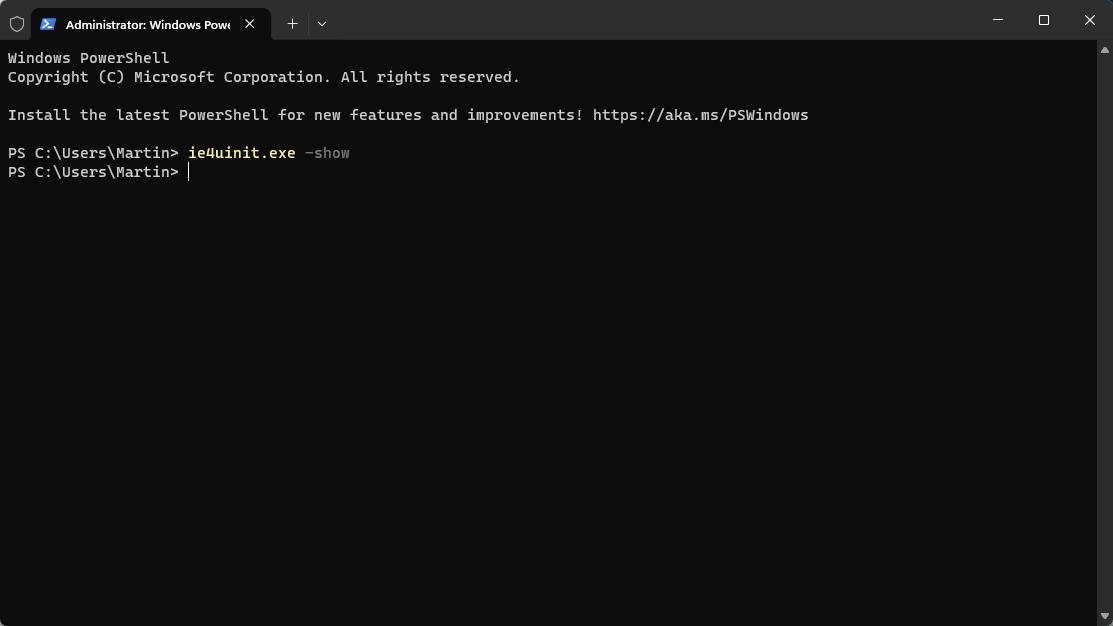
The quickest fix is the built-in ie4uinit.exe command, which tells Windows to refresh the icons it displays. Try it first, because it takes seconds and does not close any windows.
- Right-click Start (or press Windows-X) and select Terminal.
- Type ie4uinit.exe -show and press Enter.
- Look at the desktop and taskbar to see whether the icons have been redrawn.
Do not expect a confirmation message; check the icons themselves. Run the command as the user who sees the broken icons. If the wrong icons are still there after a few seconds, the cache files themselves are probably corrupt, and Method 2 deletes them.
Method 2: Delete the icon cache files with Command Prompt
Deleting the icon cache files forces Windows 11 to build a completely new cache. Save open work first: the commands stop Explorer, so the taskbar and desktop disappear until the last command brings them back.
- Open the Start menu, type cmd and select Command Prompt.
- Run taskkill /IM explorer.exe /F to stop Explorer.
- Run del /A /F /Q "%localappdata%\IconCache.db" to remove the old main cache file, if it exists.
- Run del /A /F /Q "%localappdata%\Microsoft\Windows\Explorer\iconcache*" to remove the icon cache databases.
- Run start explorer.exe to bring back the taskbar and desktop.
What the switches do:
- /IM explorer.exe /F selects the Explorer process by name and forces it to close, so it releases its lock on the cache files.
- /A selects files by attribute, so the hidden cache files are included in the deletion.
- /F deletes read-only files, and /Q skips the confirmation prompt.
If Command Prompt reports that a file is in use, restart the PC and run the commands again before opening other programs. If the taskbar does not come back after step 5, sign out and sign back in, which starts Explorer again.
Where Windows 11 stores the icon cache
Windows 11 keeps its icon cache in %localappdata%\Microsoft\Windows\Explorer, in a group of files whose names start with iconcache_ and end in .db. Several files exist because icons are stored in separate databases, for example by icon size. That folder also holds the thumbcache files for picture and video previews.
Older guides focus on a single IconCache.db file directly in %localappdata% (C:\Users\your-name\AppData\Local). On Windows 7 that file was the icon cache. Since Windows 8, the iconcache_*.db files in the Explorer folder hold the icon images, which is why deleting IconCache.db alone often changes nothing on Windows 11.
If you cannot find IconCache.db, check two things before you assume something is wrong:
- The file is hidden, so File Explorer does not list it by default. The del command from Method 2 includes hidden files, so you can run it without finding the file first.
- The file may not exist on your PC at all. A missing IconCache.db is not an error on Windows 11, because the cache that matters lives in the Explorer folder.
One trap catches people on shared PCs: the cache is per user. If you run the commands in a window elevated with a different administrator account, %localappdata% points to that account's profile and your own cache stays untouched. Run the commands as the user who sees the broken icons.
When rebuilding the icon cache does not fix the problem
Rebuilding the icon cache only helps when the cache is wrong. Many icon problems have a different cause, and the table matches the symptom to the right fix.
| Symptom | Likely cause | What to do |
|---|---|---|
| Old, wrong or generic icons on apps and shortcuts | Corrupt or outdated icon cache | Method 1, then Method 2 |
| Wrong or missing previews of photos, videos or documents | Thumbnail cache, not icon cache | Clear thumbnails in Settings or Disk Cleanup |
| Blank icon on one shortcut only | Target program moved, renamed or uninstalled | Recreate the shortcut or reinstall the program |
| Missing or stale system tray icons | Tray icon settings | Check the taskbar overflow settings |
To clear the thumbnail cache, open Settings, go to System, then Storage, then Temporary files, clear the other selections, check Thumbnails and select Remove files. Disk Cleanup offers the same Thumbnails option. If icons for a file type stay wrong after both caches are rebuilt, check which program is the default for that file type, since the icon comes from the associated app.
For tray problems, our guide on showing all system tray icons in Windows 11 walks through the settings. If folder previews are the issue rather than icons, see how to display full folder thumbnails in Windows 11.
FAQ
Is it safe to delete iconcache.db and the iconcache files?
Yes. The files only hold cached copies of icons, and Windows rebuilds them automatically. You do not lose shortcuts, files or settings.
Do I need to restart Windows 11 after rebuilding the icon cache?
Usually not. Restarting Explorer with start explorer.exe is enough. Restart the PC only if some cache files were in use and could not be deleted.
Can I rebuild the icon cache with a batch file?
Yes. Paste the five commands from Method 2 into a text file, save it with a .bat extension and double-click it whenever icons break. Run it as your normal user, not from another administrator account.
Related: Windows Maintenance Tool for one-click repairs, How to display all cached DNS entries on Windows, Open File Explorer to the Downloads folder in Windows 11

I wonder what the command ie4uinit.exe does ?
I use DesktopOK because depending on my background image, I use 1 of 3 icon sizes.
Best solution ever with no unexpected bad secondary effects:
1. Make all direct access you need of all programs you missed, directly to desktop.
2. Move all these recently created direct access icons to these next folder:
C:\ProgramData\Microsoft\Windows\Start Menu\Programs\
Reboot and enjoy the new 2025 with all the icons!
This has worked for me and it helped me to fix some issues with icons, thanks.
I remember using a different command in Windows 10/11, I think one from Windows 7 and it worked.
icon cache is deleted and rebuilt at each reboot…this is ridiculous…
What about people that don’t reboot? Geez, it’s just “me, me, me” with you guys. Think about others for a change.
I’ve never needed to do this with 11.
With 10 there was an issue with dpi scaling that would cause the tray icons to get all blurry when I changed the resolution alot, as I did when gaming, and rebuilding the iconcache would fix it temporarily.
I found a little tool “WindowsDpiFix.exe” that solved the problem instead of the symptom.
https://www.majorgeeks.com/files/details/windows_10_dpi_fix.html
If you have Windows 11 version that works great, you do not need updates. Even security ones (in my opinion). Just get a good third-party antivirus and full back up program with an external local storage device or two. And you can disable Windows Updates forever.
That makes sense now don’t you think?
How about: https://www.sordum.org/,
States: “restore desktop icon layout”.