Get the latest updates as soon as they're available greyed out? What the Windows 11 setting does and how to fix it

"Get the latest updates as soon as they're available" is a toggle in Settings > Windows Update that puts your PC at the front of the queue for non-security updates, new features and fixes. If the toggle is greyed out, a Windows Update policy is controlling it, usually "Enable optional updates" (AllowOptionalContent) or a target release version policy. Change or remove that policy and the toggle becomes available again.
This guide explains what the setting does, whether you should turn it on or off, and how to fix a greyed-out toggle on Windows 11 with Group Policy or the Registry.
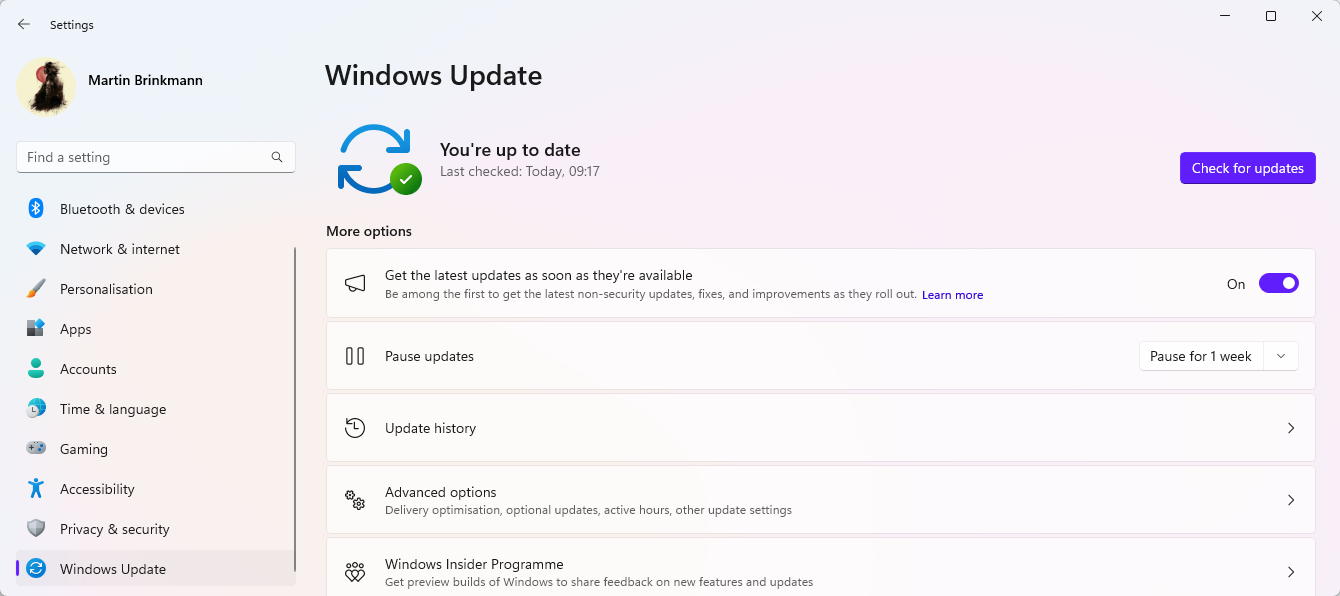
What does "Get the latest updates as soon as they're available" do?
The "Get the latest updates as soon as they're available" toggle prioritizes your device for non-security updates and new features as soon as Microsoft makes them available for it. Microsoft rolls out many Windows 11 features gradually, a method called controlled feature rollout (CFR) or continuous innovation. Without the toggle, a feature that ships in a monthly update can stay switched off on your PC for weeks while it reaches other devices first. With the toggle on, those features and improvements are enabled as early as Microsoft allows for your hardware.
The toggle does not change security updates. Microsoft's support page for the setting states that you get the regular security updates whether the toggle is set to On or Off.
What it does change:
- Optional non-security updates and gradually rolled out features arrive earlier.
- There may be more restarts per month, although Windows respects active hours and lets you schedule restarts.
- Turning it back off later does not remove features or updates that were already applied.
Microsoft added the toggle to stable Windows 11, version 22H2, in 2023, and tested it with Insiders before that.
How to turn the setting on or off
You turn the setting on or off on the main Windows Update page in Settings. It is off by default.
- Open Start and select Settings, or press Windows + I.
- Select Windows Update in the sidebar.
- Set "Get the latest updates as soon as they're available" to On or Off.
- Select Check for updates and restart if Windows prompts you to.
Should you turn it on or off? Turn it on if you want new Windows 11 features early and accept that early code occasionally has bugs. This is why some users see a new feature right after installing an update while others, like many after the KB5026446 feature update, did not. Leave it off on PCs where stability matters more than new features, for example a work machine or a PC you maintain for someone else. Security protection is the same either way. If you want to understand the optional updates the toggle pulls in, see our explainer on whether to install Windows preview updates.
Why is "Get the latest updates as soon as they're available" greyed out?
The toggle is greyed out when a Windows Update policy controls it. Settings then shows a note that some settings are managed by your organization. Common causes:
- The PC is managed by work or school IT through Group Policy, Intune or another MDM, or Windows Server Update Services (WSUS).
- The "Enable optional updates" policy (CSP name AllowOptionalContent) is set to a value that locks the toggle.
- A target release version policy ("Select the target Feature Update version") pins the PC to a specific Windows version.
- A tweaking tool, debloat script or update blocker wrote policy values to the Registry on a home PC.
On a work or school device, ask your IT administrator. The policy is intentional there, and local changes are usually overwritten by the next policy refresh. On a personal PC, the fixes in the next two sections remove or change the policy.
Fix the greyed-out toggle with Group Policy
The Group Policy fix is to set "Enable optional updates" to the option that hands control back to the user. This works on Windows 11 Pro, Enterprise and Education, which include the Local Group Policy Editor.
- Press Windows + R, type gpedit.msc and press Enter.
- Go to Computer Configuration > Administrative Templates > Windows Components > Windows Update > Manage updates offered from Windows Update.
- Open Enable optional updates.
- Select Enabled and choose "Users can select which optional updates to receive", or select Not Configured to remove the policy completely.
- Also check "Select the target Feature Update version" in the same folder and set it to Not Configured if you do not need it.
- Select OK, restart the PC and open Settings > Windows Update again.
The Enable optional updates policy has three enabled options:
| Option | AllowOptionalContent value | Effect |
|---|---|---|
| Automatically receive optional updates (including CFRs) | 1 | Optional cumulative updates and gradual feature rollouts install automatically |
| Automatically receive optional updates | 2 | Optional cumulative updates install automatically, without CFRs |
| Users can select which optional updates to receive | 3 | The user decides in Settings and can turn on the toggle |
Value 0, the default, means the device does not receive optional updates. The two automatic options follow any configured quality update deferrals, according to Microsoft's Policy CSP documentation.
Fix it with the Registry (Windows 11 Home)
The Registry fix removes the Windows Update policy values that lock the toggle, which is the route for Windows 11 Home, where gpedit.msc is not available. Create a restore point first.
- Press Windows + R, type regedit and press Enter.
- Go to HKEY_LOCAL_MACHINE\SOFTWARE\Policies\Microsoft\Windows\WindowsUpdate.
- Delete the values SetAllowOptionalContent, AllowOptionalContent, TargetReleaseVersion and TargetReleaseVersionInfo if they exist.
- Restart the PC and open Settings > Windows Update.
SetAllowOptionalContent is the Registry value the "Enable optional updates" Group Policy writes. If you prefer the command line, an elevated Command Prompt can remove the whole policy key with reg delete "HKLM\SOFTWARE\Policies\Microsoft\Windows\WindowsUpdate" /f. This also removes any other update policies under that key, including ones you set on purpose, such as deferrals or settings written by a tool that stops Windows from downloading updates automatically. Do not use it on a managed PC.
Managed devices: enable features introduced via servicing
On devices whose updates are managed through Windows Update for Business or WSUS, features delivered in monthly updates stay off by default even when the update is installed. Administrators control this with a separate policy.

The policy is "Enable features introduced via servicing that are off by default" under Computer Configuration > Administrative Templates > Windows Components > Windows Update > Manage end user experience. Set to Enabled, it turns on all features in the latest installed monthly quality update. Not Configured or Disabled keeps those features off until the annual feature update that includes them. It requires Windows 11, version 22H2 with KB5022913 or later, and writes the value AllowTemporaryEnterpriseFeatureControl under the same WindowsUpdate policy key.
FAQ
Does turning the toggle on make Windows less secure?
No. Security updates arrive on the same schedule whether the toggle is on or off. The toggle only changes how fast you get non-security updates and features.
Is the setting available on Windows 10?
Microsoft's support page for the toggle lists Windows 10 among the versions it applies to, and the AllowOptionalContent policy works on Windows 10, version 21H2 and later from build 19044.3757. The Group Policy path on Windows 10 can sit under Windows Update for Business instead of Manage updates offered from Windows Update.
Do I need to restart after turning it on?
Microsoft notes that enabling the setting can require a restart, and that devices with the toggle on may restart more often per month to apply changes.
Related: Windows 11 Moments features rollout, Windows Update Blocker

No thanks these updates typically are released to early into mainstream as it is. I don’t want to be yet another beta tester.
Is there a choice that is exactly the opposite of this? Simple interface like Windows 7, no pointless features, only security updates.
“Whether it is a good idea to get the features early is up for debate. While it is nice to have as early access as possible on stable machines, it may also lead to new issues.”
Don’t remember a time when MS has released an update of any type that turned a “stable” computer into something better, a computer with a feature that I really wanted/needed to provide more depth to my computing life. Usually, it takes at least 1/2 hour to sort out the mess the update made.
MS “Features” are so mundane.
The excellent “ViveTool”? Perhaps, but what is the rush?
I wait for weeks and then whenever. Working with Windows rarely provides a “peak experience” moment.
A simple project the other day was fun: Needed VLC, Handbrake and a Desktop. A second computer was needed to make sure VLC and/or Windows 11 wasn’t the problem. Yeah, that was a neat project.
Oh well . . . !
Well, I won’t be using Windows 11 for at least two more years, but if I was forced to use it, I’d love this feature. Let the people who want to be beta testers work through all the bugs so people like me can wait as long as possible before updating. The unfortunate part of this, however, is that unsophisticated users who don’t know enough to change settings are being forced to work thorough all of Microsoft’s bugs and other problems.
lol, a sign up for beta button.
Moments 3, an entire release just to see the seconds at taskbar. Two years waiting to put a single taskbar on top, to not combine taskbar icons, to get an only click at explorer’s menu and so forth.
All those “moments” will be lost in time like tears in the rain.
You took the words right out of my mouth.
Not a big loss, unlike the amazing movie!
Reading this makes me still wonder why anyone would want to experience this. Windows 10 will have full security patch support until October 2025. So why not migrate from 10 to 11 after they decided to not mess around with it anymore?
Rewinding all terrible UI/UX decisions back to the state of Windows 10 just proves me right that 11 has no concept and they merely push changes for a mere feeling of novelty.
@Frankel > “Rewinding all terrible UI/UX decisions back to the state of Windows 10 just proves me right that 11 has no concept and they merely push changes for a mere feeling of novelty.”
That’s it!