Fast.com: How the Netflix Speed Test Works and What Results Mean
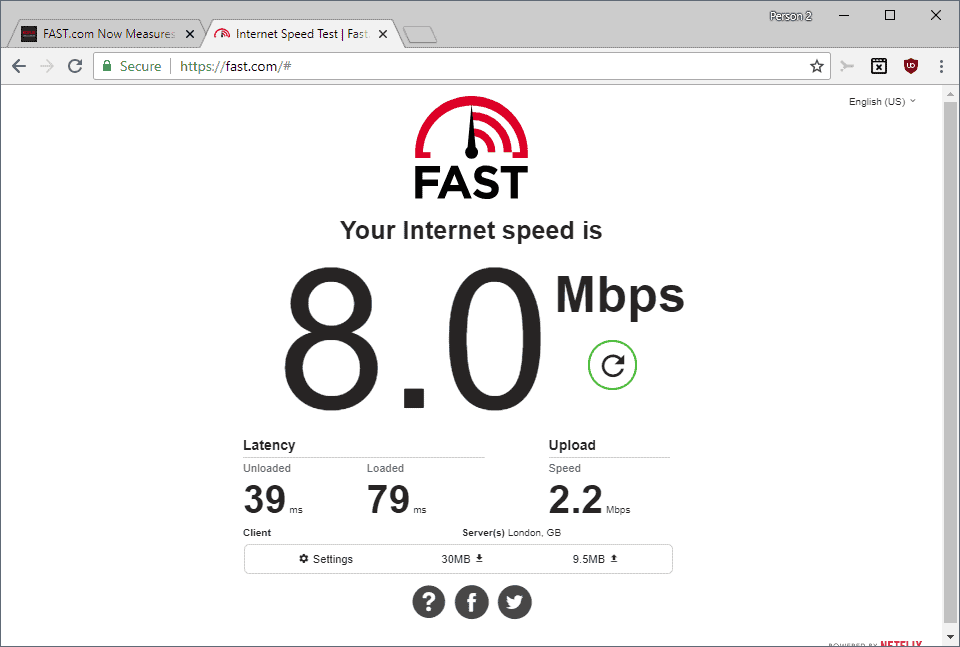
Fast.com is Netflix's free internet speed test. Open fast.com in any browser and it starts measuring your download speed straight away, with no ads and no button to press. Click "Show more info" to add upload speed and latency (ping), both unloaded and loaded. The test downloads data from Netflix's own servers, so the result shows how fast your connection can pull content from Netflix and similar services.
This guide explains what each Fast.com number means, how the test works, which settings you can change, what speed Netflix needs for each quality level, and how Fast.com compares with other speed tests.
How to run the Netflix speed test on Fast.com
The Netflix speed test runs automatically: the measurement begins as soon as fast.com loads. Netflix says the site works worldwide on phones, laptops and smart TVs with a browser, and it is open to everyone, not only Netflix members.
- Close downloads, streams and cloud backups on your network so they do not skew the result.
- Open fast.com in a browser. The download test starts on its own and the number settles after a few seconds.
- Click "Show more info" to measure upload speed and latency.
- Run the test two or three times, ideally once on a wired connection and once on Wi-Fi, to see whether the router or the line is the bottleneck.
On Android, Netflix publishes the same test as the FAST Speed Test app on Google Play. On a TV or streaming device, Netflix points users to the "Check your Network" option in the Netflix app's Get Help menu instead.
What the Fast.com results mean
Fast.com shows up to four values, and each one answers a different question about your connection.
| Metric | What it tells you |
|---|---|
| Internet speed (download) | How fast data reaches your device, in Mbps. This decides streaming quality and download times. |
| Upload | How fast data leaves your device, in Mbps. Matters for video calls, cloud backups and sending large files. |
| Unloaded latency | Round-trip time in milliseconds when no other traffic is on your network (classic ping). |
| Loaded latency | Round-trip time while the connection is busy with data-heavy traffic. |
Netflix added upload speed and both latency values in July 2018, when it announced that Fast.com had passed half a billion tests. Ideally, loaded and unloaded latency stay close. A large gap, which Fast.com labels bufferbloat, explains lag in gaming, video calls and browsing whenever someone else on the network streams or uploads. Netflix suggests checking your home network setup or talking to your ISP if the gap is big. For a longer look at stability rather than a single snapshot, see our guide to testing the reliability of an internet connection.
How Fast.com measures your speed
Fast.com measures speed by running a series of downloads and uploads against Netflix servers and reporting the result. The servers are Netflix Open Connect Appliances, the same caches that deliver Netflix video, and many of them sit inside or close to ISP networks.
According to a Netflix engineering presentation at RIPE 74, the site asks an API for nearby healthy servers on a good network path, uses IPv6 where possible and transfers test files over HTTPS only. It opens several parallel connections, adding more only when throughput is high enough, ignores the TCP ramp-up phase and stops once the measured speed stays stable within a few percent.
Two practical consequences follow:
- The result reflects real streaming conditions, because the traffic looks like Netflix traffic and travels the same route.
- Because the test is browser based, a slow device, a busy browser or a weak Wi-Fi signal can lower the number even when the line itself is fast.
Fast.com is built on HTML5 like most modern speed tests, so it needs no plugin. Netflix says it is not designed or supported for enterprise bandwidth certification or third-party service certification.
Fast.com settings you can change
Fast.com has a Settings link under "Show more info" that lets you tune how the test runs. The options are:
- Parallel connections: a minimum and maximum number of simultaneous connections.
- Test duration: a minimum and maximum run time in seconds.
- Measure loaded latency during upload.
- Always show all metrics, so upload and latency appear without clicking "Show more info".
- Save config for this device, so the choices persist on that browser.
A Reset button restores the defaults. Raising the maximum duration gives a fast but variable connection more time to settle, and raising the connection count helps saturate very fast fiber lines. Enabling "Always show all metrics" is the most useful change for most people, because it turns Fast.com from a download-only check into a full test every time.
What internet speed Netflix needs
Netflix's help center lists these recommended speeds per stream:
| Video quality | Recommended speed |
|---|---|
| HD (720p) | About 3 Mbps |
| Full HD (1080p) | About 5 Mbps |
| 4K Ultra HD | About 15 Mbps |
These figures apply to one stream, so add them up for every TV or device that streams at the same time, and leave headroom for other traffic. Netflix also stresses a stable connection over raw speed. If Fast.com regularly shows less than the speed you pay for, Netflix recommends contacting your ISP; if your data plan is capped, lowering the playback quality reduces how much data Netflix uses.
Fast.com vs Speedtest.net and other speed tests
Fast.com and Speedtest.net both measure download, upload and latency, but they test against different servers. Fast.com always uses Netflix's own delivery servers, while Speedtest.net by Ookla runs against a large network of third-party test servers and lets you pick one.
| Aspect | Fast.com | Speedtest.net |
|---|---|---|
| Operator | Netflix | Ookla |
| Test servers | Netflix Open Connect servers | Third-party servers, selectable |
| Starts | Automatically on page load | After you press Go |
Different numbers from the two sites are normal: each measures the path to its own servers. Use Fast.com to answer "is my connection good enough for streaming?" and a server-selectable test to check speed to a specific region. If only one test is slow, the problem is usually routing or the server, not your line. For browsing that feels slow while speed tests look fine, check DNS: our guide to viewing cached DNS entries on Windows is a good starting point.
FAQ
Is Fast.com accurate?
Fast.com gives an accurate estimate of the speed between your device and Netflix's servers, which is what matters for streaming. Results can still be lower than your plan's speed because of Wi-Fi, the device or other traffic on the network, so test on a wired connection for the most reliable figure.
Do I need a Netflix account to use Fast.com?
No. Fast.com is free for anyone and requires no sign-in or Netflix subscription.
Why does Fast.com only show download speed?
Netflix shows download speed first because it matters most for consuming content and keeps the test quick. Click "Show more info" for upload and latency, or enable "Always show all metrics" in the settings.
What is a good ping on Fast.com?
Lower is better, and the gap matters as much as the number: unloaded and loaded latency should be close. A loaded latency far above the unloaded value points to bufferbloat, which causes lag while the network is busy.
Related: turning Wi-Fi on or off in Windows 11, Netflix "Are you still watching?" prompts, enabling secure DNS in your browser

I still do not know what the numbers at the bottom of the fast.com screen mean? 30MB and 9.5MB
Latency is the time (in milliseconds) that it takes for the ping to return to the computer.
Also, check this one – https://www.netspeed.xyz/
Thanks
The article tells you to “change” the 4 values under ‘settings’.
Do we increase them? Decrease them?
“Change” them to what????
Ugh.
Netflix speed test is a joke.
@Tom Hawack – Thanks for listing the speed testing sites, it was interesting to see my results. I’m wondering why all of them except DSLReports.com and SpeedTest.net give such poor results. On those two sites (as well as SpeedTest.net’s Windows 10 app) my U/D results are around 80Mbps/90Mbps. The rest of the bunch give me U/D results of about 30Mbps/30Mbps.
@Keith S.
First, you’ve got similar DL and UL flows which is a good thing. I’d prefer to have 80/80 as you than my 190/17.
As for the differences from one speed tester to another I guess as others have suggested that it’s related to the servers used by those testers, be they far or near from your computer location.
I get significantly lower download speed with Fast.com than with Speedtest.net (180MB/s vs. 193MB/s)
My DL/UL speed testers :
1- Speedtest by Ookla (HTML5) at http://www.speedtest.net/
2- SpeedOf.Me Speed Test (HTML5) at https://speedof.me/
3- Bandwith Place Speed Test (HTML5) at https://www.bandwidthplace.com/
4- TestMy.net Upload Speed Test at https://testmy.net/upload
5- DSLReports Speed test at https://www.dslreports.com/speedtest
6- Fast Internet Speed Test at https://fast.com/en/#
All are considered should the first (Ookla) provide an unusual result, which never happens with regular 190+MB/s and 17+MB/s speed results.
Can you try testing with https://whatismyip.live/speed-test and let me know what results do you get.
@Katherine, not sure if you were asking chesscanoe or me.
Testing https://whatismyip.live/speed-test gives me similar results to Ookla (190MB+ & 17MB+) and indicates their server as located in Saarbrücken, Germany with my IP in France.
Ookla gives me the results I expect using a server 100 miles away by default. Fast IS uses by default a server 1900 miles away for me. Naturally its numbers are significantly lower.
Interesting fast.com says 80 mb/s while Bing and others say 100 mb/s or more.
How are they able to compute the “loaded” value?
My favorite speed test is:
https://testmy.net/
I find a lot to like in their statistics and historical record keeping
I just discovered TestMy.net and indeed seems complete, interesting.
jio fast internet
speed just
I’ve been relying on https://speedof.me
for quite a while but fast.com appears to be a little more configurable.
Thanks for posting this.
The figures that I am getting from the Netflix measurements site are not correct I am getting:
Latency: Upload (Ping) 10ms, Speed 180 Mbps Upload: speed 19 ms.
After testing a few seconds after the Netflix test under the same conditions with other sources (like Ookla and speedtest.net.in) I am getting main normale figures who are at least.
Latency: Upload (Ping) 9ms, Speed 208 Mbps Upload: speed 20.50 ms.
How are those figures explained from Netflix? Why are they so low?
When I would like to make a funny remark could I say they are about the same quality as there tv series and movies?
Only that pothead from the tv stand up show Real Time with Bill Maher is funny on Netflix. But that’s main personal point of view! :-)
Like me I have Extreme 350 internet. i have found an issue that i believe to be Comcast. if you dont change anything it does one single connection and it will run slow, today it will slow way down to 25 Mbps. if i put in 24 parallel connections MIN and 36 Max, i get a steady 350-360 floating and i did a min 500 Sec test. WATCHOUT that consumes about 25Gb of data so if your one that is capped it will eat your data VERY fast. I have unlimited still and so i was stress testing my connection. being able to put as many parallel connections as i want allows me to speed up the connection. I have 1Gb at work and I have to use 48 parallel connections min to get that full speed. At the same time though if you put more then you can handle then you will slow your self down. so it’s a balance to know how many parallel connections you need for your speed. rule of thumb, add about 6 each time until you get stable and run the test for a min of 120 seconds to get a steady number.
Speedtest has nothing to do with Netflix test.
Speedtest usually meseaurs the speed to your ISP’s servers which are not real world Internet network speed as you connect to many other servers, like ghacks… try test connecting to a server in Antarctica or Tokyo…
Netflix tests the speed of their streaming service from their own servers which could be thousans miles away from you. For an ok Netflix service speed should be about 25Mbps.
I don’t understand this value
internet speed com
I get “Backend not available” with the rest of the page totally blank :-)