AMD Radeon RX 7600: Specs, Wattage, PSU requirements
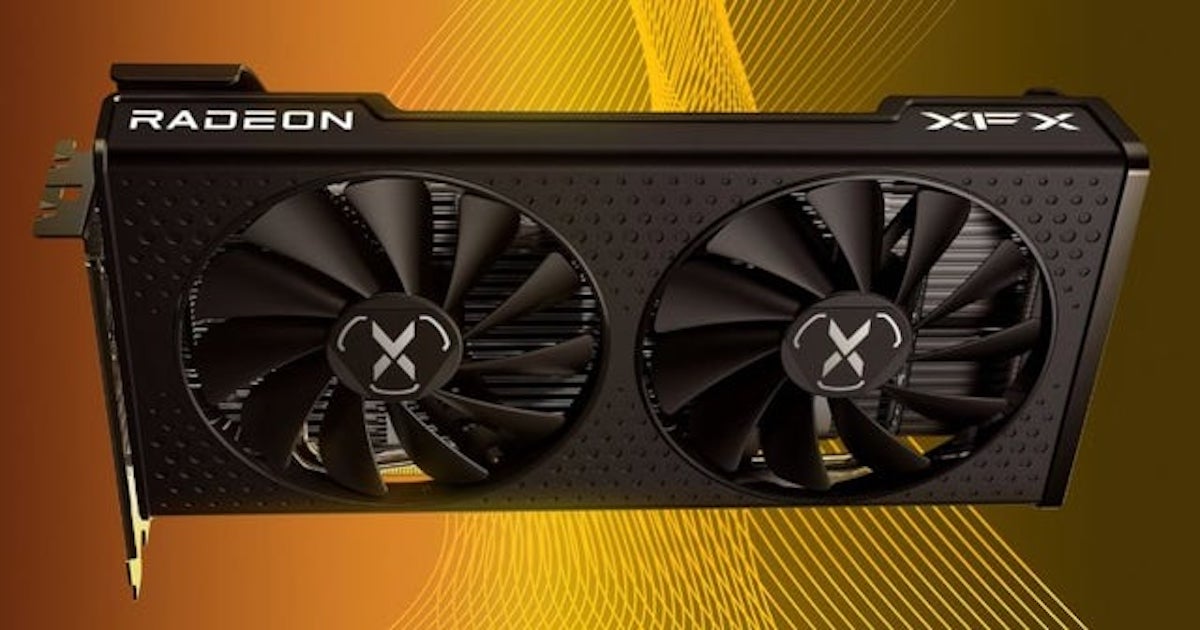
The AMD Radeon RX 7600 needs a power supply of 550 W or more with over 40 A on the 12 V rail and one 8-pin PCIe power connector. AMD rates its total board power, the figure most spec sheets list as TDP, at 165 W. The card is a 1080p RDNA 3 GPU with 32 compute units, 8 GB of GDDR6 and a boost clock of up to 2,655 MHz, launched on May 25, 2023 at $269.
This page collects the official specifications from AMD's product page, explains what the wattage and PSU figures mean for your build, and compares the card with the Radeon RX 6600 it replaced.
AMD Radeon RX 7600 specifications
The Radeon RX 7600 uses AMD's Navi 33 GPU, built on a 6 nm process and connected over PCIe 4.0 x8. The table lists the figures AMD publishes for the reference specification; partner cards from ASUS, PowerColor, Sapphire and others may ship with higher factory clocks.
| Specification | Radeon RX 7600 |
|---|---|
| Architecture and GPU | RDNA 3, Navi 33, 6 nm |
| Compute units / stream processors | 32 / 2,048 |
| Ray accelerators / AI accelerators | 32 / 64 |
| Game clock / boost clock | 2,250 MHz / up to 2,655 MHz |
| Memory | 8 GB GDDR6, 18 Gbps, 128-bit |
| Memory bandwidth | 288 GB/s (up to 477 GB/s effective with 32 MB Infinity Cache) |
| Transistors | 13.3 billion |
| Peak FP32 performance | 21.7 TFLOPS |
| Bus interface | PCIe 4.0 x8 |
| Display outputs | HDMI 2.1, DisplayPort up to 2.1 |
| Video engine | AV1, HEVC and H.264 encode and decode |
| Size (reference) | 2 slots, 204 mm long |
| Launch price | $269 (SEP), May 25, 2023 |
Pre-launch leaks listed a 2,625 MHz boost clock; AMD's final figure is up to 2,655 MHz. Use the official RX 7600 product page as the reference when spec sheets disagree.

RX 7600 wattage: how much power does it use?
The Radeon RX 7600 has a total board power (TBP) of 165 W, the number usually quoted as its TDP. It is the power budget for the whole card, not just the GPU chip. That is the number to plan around when you size a power supply or estimate heat output.
Real draw depends on the game, the resolution and the card model, so treat 165 W as the typical figure for a reference-clocked card under gaming load. Factory-overclocked partner cards can draw more, so check the manufacturer's spec page for the exact model you buy.
For context, the RX 7600 uses more than 30 W over its predecessor: the RX 6600 was rated at 132 W. The extra budget pays for higher clocks and the RDNA 3 compute units, and it is why AMD raised the PSU recommendation by 100 W.
If you want to watch real-time power and GPU load on your own system, Windows 11 can show CPU, GPU and RAM usage natively, which helps you see how hard the card is working in a given game.
RX 7600 PSU requirements
AMD recommends a 550 W or higher power supply for the Radeon RX 7600, with a 12 V rail rated above 40 A. The reference card needs one 8-pin PCIe power connector.
Use this checklist before you buy or install the card:
- Rated wattage: 550 W is AMD's figure for a typical system. A mid-range CPU leaves comfortable headroom; a high-end CPU with many drives and fans is a reason to step up.
- 12 V capacity: the 12 V rail (or combined 12 V output) should exceed 40 A, which is 480 W or more on 12 V.
- Connector: one native 8-pin PCIe cable. Avoid SATA or Molex adapters. Some partner models use different connectors, so check the box.
- Quality: a unit from a known brand with 80 PLUS certification holds its rated output better than a cheap unit with the same label.
- Case fit: the reference card is two slots and 204 mm long; partner cards with triple fans are often longer.
A good 500 W unit can run the card in a modest build, but staying at or above AMD's 550 W recommendation keeps the PSU out of its upper load range and avoids crashes under transient spikes.
RX 7600 vs RX 6600: what changed
The RX 7600 moves from RDNA 2 to RDNA 3 and keeps the same 8 GB, 128-bit memory layout as the RX 6600, but with faster memory and more power.
| Attribute | RX 6600 | RX 7600 |
|---|---|---|
| Architecture | RDNA 2, Navi 23, 7 nm | RDNA 3, Navi 33, 6 nm |
| Total board power | 132 W | 165 W |
| Recommended PSU | 450 W | 550 W |
| Memory | 8 GB GDDR6, 128-bit | 8 GB GDDR6 at 18 Gbps, 128-bit |
| AI accelerators | None | 64 |

The main competitor at launch was Nvidia's GeForce RTX 4060, announced days earlier; see our RTX 4060 and RTX 4060 Ti launch coverage for its pricing.
What the RX 7600 is built for
AMD positions the Radeon RX 7600 as a 1080p gaming card. The 8 GB frame buffer suits 1080p at high settings in most games; recent titles at maximum textures can exceed it, so lowering texture quality is the usual fix.
Upscaling stretches the card further. FidelityFX Super Resolution is supported in a large library of games, and our guide on what AMD FSR 3 is and how to enable it explains how the technology works and where to switch it on. The AV1 encoder is useful for streaming and recording at lower bitrates. On laptops or systems with integrated graphics, you can assign the dedicated GPU to specific programs in Windows 11.
Drivers come from AMD's RX 7600 driver page. Note that the Radeon RX 7600 XT is a separate model with its own specifications and power figures.
FAQ
Is a 500 W PSU enough for the RX 7600?
It can work in a low-power build with a quality unit, but AMD's recommendation is 550 W or higher with more than 40 A on the 12 V rail. Staying at or above that figure is the safer choice.
How many power connectors does the RX 7600 need?
The reference RX 7600 uses a single 8-pin PCIe power connector. Partner cards can differ, so check the model's spec sheet.
Does the RX 7600 work in a PCIe 3.0 slot?
Yes, PCIe is backward compatible, so the card runs in a PCIe 3.0 slot. Because it uses only eight lanes, the link runs at PCIe 3.0 x8 speed there, which can cost some performance in games that exceed the 8 GB of video memory.
Related: AMD FSR 3 explained, monitor GPU usage in Windows 11, Nvidia RTX 4060 launch

We now have the price: $269