iPhone 14 vs iPhone 14 Plus vs iPhone 14 Pro Max: Key Differences
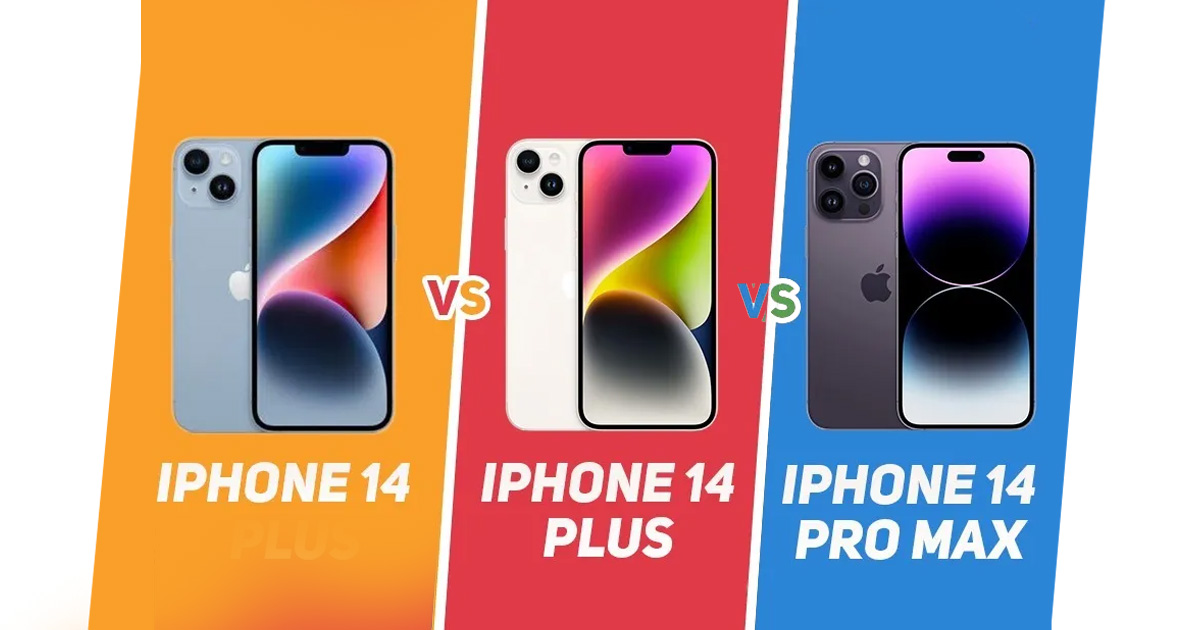
The iPhone 14 and iPhone 14 Plus share the A15 Bionic chip, a 12 MP dual camera and a 60 Hz display, and differ mainly in screen size (6.1 vs 6.7 inches) and battery life. The iPhone 14 Pro Max adds the A16 Bionic, a 48 MP main camera with a 3x telephoto, a 120 Hz ProMotion always-on display, the Dynamic Island, a stainless steel frame and the longest battery life of the three.
For anyone weighing the iPhone 14 Plus vs Pro Max (or the smaller iPhone 14), this comparison uses Apple's archived technical specifications for the iPhone 14, the iPhone 14 Plus and the iPhone 14 Pro Max, and ends with what matters when you buy one today, now that Apple no longer sells any of them new.
iPhone 14 vs 14 Plus vs 14 Pro Max: spec table
The iPhone 14 Pro Max leads on display, chip, cameras and battery, while the iPhone 14 Plus gives you the same 6.7-inch screen size at a lower weight. The figures below come from Apple's technical specification pages for each model.
| Spec | iPhone 14 | iPhone 14 Plus | iPhone 14 Pro Max |
|---|---|---|---|
| Display | 6.1-inch OLED, 2532 x 1170, 60 Hz | 6.7-inch OLED, 2778 x 1284, 60 Hz | 6.7-inch OLED, 2796 x 1290, ProMotion up to 120 Hz, Always-On |
| Peak brightness | 800 nits typical, 1,200 nits HDR | 800 nits typical, 1,200 nits HDR | 1,000 nits typical, 1,600 nits HDR, 2,000 nits outdoor |
| Top of screen | Notch | Notch | Dynamic Island |
| Chip | A15 Bionic (5-core GPU) | A15 Bionic (5-core GPU) | A16 Bionic (5-core GPU) |
| Rear cameras | 12 MP main, 12 MP ultra wide | 12 MP main, 12 MP ultra wide | 48 MP main, 12 MP ultra wide, 12 MP 3x telephoto |
| Video playback (Apple rating) | Up to 20 hours | Up to 26 hours | Up to 29 hours |
| Storage | 128, 256, 512 GB | 128, 256, 512 GB | 128, 256, 512 GB, 1 TB |
| Frame | Aluminium | Aluminium | Stainless steel |
| Weight | 172 g | 203 g | 240 g |
All three use a Lightning port, support MagSafe charging at up to 15 W, and include Emergency SOS via satellite and Crash Detection.
Display and size
The iPhone 14 Plus and the iPhone 14 Pro Max both have 6.7-inch screens, so the Plus is not a smaller phone than the Pro Max: the two have nearly the same footprint (160.8 mm vs 160.7 mm tall). The iPhone 14 is the compact option at 6.1 inches and 146.7 mm tall.
What separates the large models is the panel. The iPhone 14 and 14 Plus run at a fixed 60 Hz, which makes scrolling look less fluid than on most current phones. The Pro Max uses ProMotion, which adapts the refresh rate up to 120 Hz, and it can stay on in a dimmed always-on mode showing the time, widgets and notifications. It is also brighter, rated for 2,000 nits outdoors against 1,200 nits HDR peak on the other two, which helps in direct sunlight.
The Pro Max replaces the notch with the Dynamic Island, a pill-shaped cutout that expands to show live activities such as timers, music playback and navigation. Weight is the trade-off: at 240 g the Pro Max is 37 g heavier than the 14 Plus, a difference you notice in a pocket and during one-handed use.

Chip and performance
The iPhone 14 Pro Max uses the A16 Bionic, while the iPhone 14 and 14 Plus use the A15 Bionic. Both chips have a 6-core CPU (2 performance and 4 efficiency cores), a 5-core GPU and a 16-core Neural Engine.
In daily use (messaging, browsing, streaming, photos) the gap is small, and all three phones remain fast for those tasks. The A16 matters more for demanding games, long 4K video edits and the Pro camera pipeline, which relies on it to process 48 MP images.
Software support is the same for all three. Apple lists the iPhone 14, 14 Plus and 14 Pro Max as compatible with iOS 26, and iOS 27 kept iPhone 11 and later on its supported list. None of the three supports Apple Intelligence, which Apple limits to the iPhone 15 Pro, iPhone 15 Pro Max and newer models.
Cameras
The iPhone 14 Pro Max has the clearly better camera system: a 48 MP main camera (f/1.78), a 12 MP ultra wide (f/2.2) and a 12 MP 3x telephoto (f/2.8). Apple quotes a 6x optical zoom range and digital zoom up to 15x. The 48 MP sensor also gives a 2x option at 12 MP, so you get three useful focal lengths without heavy digital cropping.
The iPhone 14 and 14 Plus share an identical camera setup:
- 12 MP main camera, f/1.5, with sensor-shift optical image stabilization
- 12 MP ultra wide camera, f/2.4, 120-degree field of view
- 12 MP front camera, f/1.9
All three record 4K video, offer Cinematic mode up to 4K HDR at 30 fps and Action mode for stabilized handheld video. Only the Pro Max records Apple ProRes (up to 4K at 30 fps, limited to 1080p on the 128 GB model) and has the 3x lens for portraits and zoomed shots. If you shoot mostly daylight snapshots and selfies, the iPhone 14 and 14 Plus are close enough; for zoom, low light at a distance and video work, the Pro Max is the one to get. Ghacks covered how far the Pro Max camera goes when a pro photographer shot the Super Bowl with an iPhone 14 Pro Max.
Battery life and charging
The iPhone 14 Pro Max has the longest battery life of the three, according to Apple's ratings, followed closely by the iPhone 14 Plus. The standard iPhone 14 trails both by a wide margin.
| Apple rating | iPhone 14 | iPhone 14 Plus | iPhone 14 Pro Max |
|---|---|---|---|
| Video playback | 20 hours | 26 hours | 29 hours |
| Streamed video | 16 hours | 20 hours | 25 hours |
| Audio playback | 80 hours | 100 hours | 95 hours |
Charging speed is similar. Apple rates the iPhone 14 and 14 Plus at up to 50 percent in around 30 minutes and the Pro Max at up to 50 percent in 35 minutes, each with a 20 W adapter or higher. All three charge wirelessly via MagSafe at up to 15 W.
On a used phone, these ratings only apply to a healthy battery. Apple says batteries in iPhone 14 models and earlier are designed to retain 80 percent of their original capacity at 500 complete charge cycles, half the 1,000 cycles Apple rates for the iPhone 15 and later. A three-year-old iPhone 14 with a worn battery can run shorter than these figures suggest, so battery health is the first thing to check.
Should you buy an iPhone 14 model today?
An iPhone 14 model is now a used or refurbished purchase only. Apple dropped the iPhone 14 Pro Max from its store after the iPhone 15 launch in September 2023 and discontinued the iPhone 14 and 14 Plus in February 2025, after announcing the iPhone 16e.
Pick by priority:
- iPhone 14: the cheapest way into the lineup if you want a smaller phone and charge daily.
- iPhone 14 Plus: big screen and long battery life at a lower weight and price than the Pro Max.
- iPhone 14 Pro Max: the best display, camera and battery of the three, worth the premium if photos or video matter.
Before you pay, run Apple's checks for buying a preowned iPhone:
- Do not buy a phone that shows "iPhone Locked to Owner" or still has Activation Lock enabled.
- Open Settings > Battery > Battery Health and check Maximum Capacity and the peak performance message.
- Open Settings > General > About and look for a Parts and Service History section; a part marked "Unknown" may be non-genuine.
- In the same About screen, "No SIM restrictions" means the phone is carrier unlocked.
- Test the cameras, speakers, microphone, buttons and display, and buy from a seller with a clear return policy.
If you need USB-C, Apple Intelligence or longer software support, compare current models instead; our overview of the iPhone 17, iPhone Air and iPhone 17 Pro lineup covers the newest options.

FAQ
Does the iPhone 14 have USB-C?
No. The iPhone 14, iPhone 14 Plus and iPhone 14 Pro Max all use a Lightning connector. Apple shipped them with a USB-C to Lightning cable.
Do US iPhone 14 models have a SIM card tray?
No. Apple states that iPhone 14 models purchased in the United States use eSIM only and do not accept physical SIM cards. Models sold in other countries have a SIM tray.
Can the iPhone 14 Pro Max use Apple Intelligence?
No. Apple Intelligence requires an iPhone 15 Pro, iPhone 15 Pro Max or a newer model, so none of the iPhone 14 models support it.
Do all three models have Emergency SOS via satellite?
Yes. The iPhone 14, 14 Plus and 14 Pro Max all support Emergency SOS via satellite and Crash Detection, which can call emergency services after a severe car crash.
Related: iPhone 17 vs iPhone Air vs iPhone 17 Pro, iPhone 14 Pro Max camera at the Super Bowl, Phone Link on Windows

I am waiting on the 15 and future variants
I expected more differences between themselves. Also considering the prices.