How to see Google results from another country
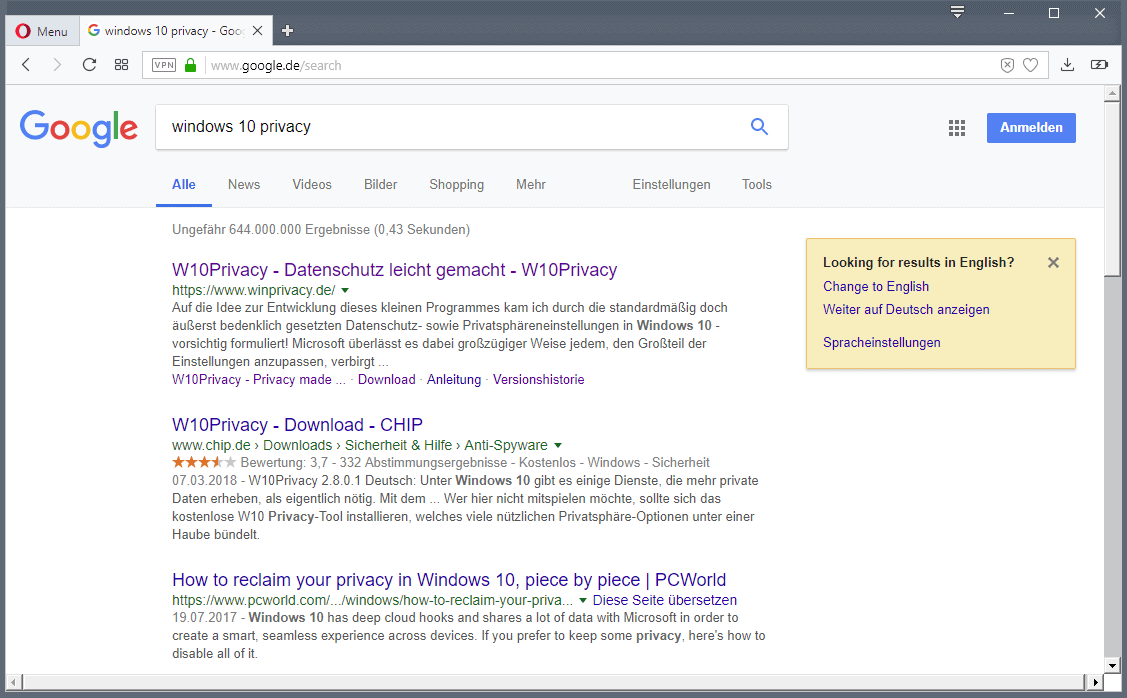
To see Google results from another country, open Google's Search settings, go to Other settings > Language and region > Results region, and pick the country you want. In the Google app, the same option is under Settings > Language & region > Search region. For one-off checks, add the hl (language) and gl (country) parameters to the search URL, or use the Region field in Google Advanced Search. A VPN is optional, not required.
This guide covers every method Google offers, what each one actually changes (country, language or both), and why local results can still leak through after you switch.
Why Google shows local results even when you search in another language
Google shows results for the place it thinks you are in, not for the language of your query. Google's help documentation lists four signals it uses to estimate your location: your device location, the home or work address saved in your Google Account, previous activity on Google sites and apps, and the IP address of your internet connection.
That is why a French developer typing an English query in Paris still gets French pages mixed in, and why an English speaker in Japan sees Japanese suggestions. Writing the query in English is not enough to get English or US results.
Two consequences follow. First, country and language are separate settings, and you often need to change both. Second, because several signals feed the estimate, changing only one of them (for example, the IP address through a VPN) may not fully switch the results. Your account can also be tied to a country for terms of service purposes; this guide explains how to check which country Google associates with your account, which is a different setting from the search region.
How to change the Google Search results region on a computer
The Results region setting in Google Search settings is the official way to view Google results from another country on a desktop browser. It works in Chrome, Firefox, Edge, Safari and any other browser.
- Open google.com/preferences, or click Settings on the Google homepage and select Search settings.
- Click Other settings in the left sidebar.
- Under Language, click Language and region.
- Click Results region. It defaults to Current region; select the country you want results from.
- Optional: set the Results language filter if you also want pages in one specific language.
Confirm the choice if Google asks you to. If you are signed in to your Google account, the setting follows you to other devices where you use the same account. If you are signed out, it is stored in a browser cookie, so you have to repeat it in every browser and after clearing cookies.
The Results region setting does not change Google Maps or "near me" searches, which keep using your detected location.
How to change the search region in the Google app on Android and iPhone
The Google app has its own Search region setting, so changing it on the website does not always carry over to the app.
- Open the Google app.
- Tap your profile picture or initial at the top right.
- Tap Settings, then Language & region, then Search region.
- Tap the country you want results from.
Google notes that if a region is missing from the list, the feature is not available for that location. In a mobile browser such as Chrome or Safari, open google.com/preferences and use the same steps as on the computer. The Google app follows your phone's system language by default, so check that as well if the interface language looks wrong.
How to get Google results in English, or in any other language
To get Google results in English, set the display language and the Results language filter to English, or add hl=en to the Google address. The display language changes Google's buttons and menus; the Results language filter limits the pages Google returns to one language.
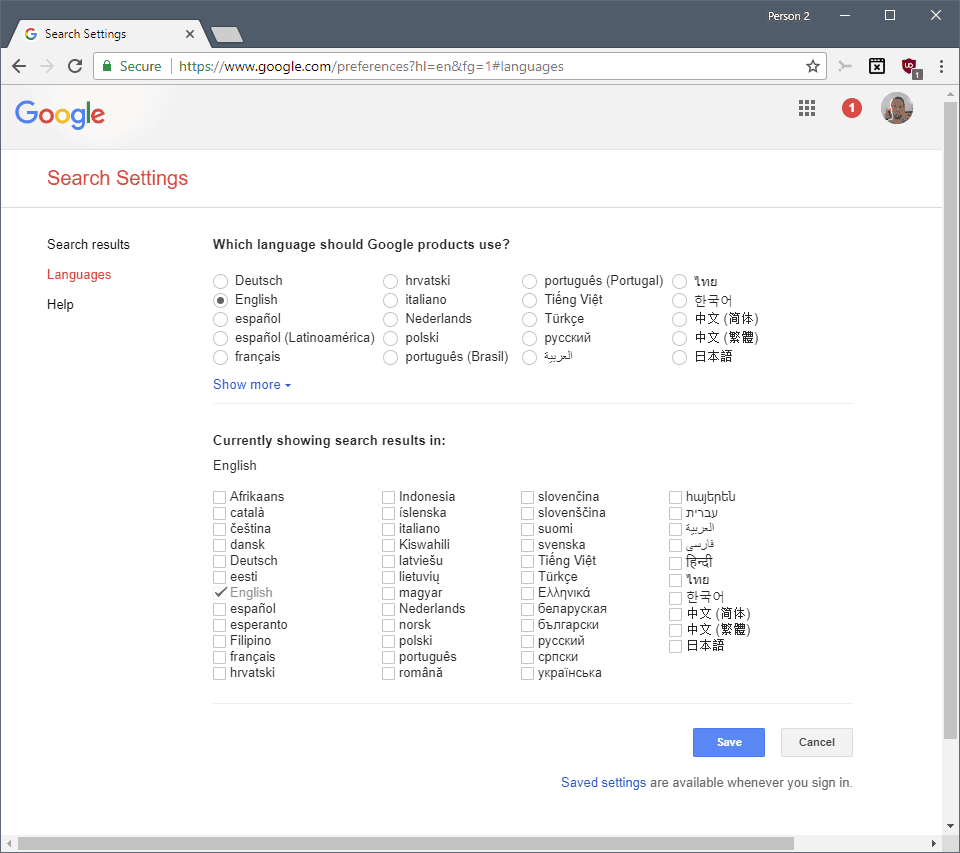
Options, from quickest to most permanent:
- URL parameter: load google.com/?hl=en for the English interface, or append &hl=fr, &hl=es and so on to a results URL for another language.
- Tools menu: on a results page, open Tools and use the language filter to show pages in one language only.
- Search settings: set Display language and Results language filter under Other settings > Language and region.
- Google account: set your preferred language at myaccount.google.com/language so Google services use it everywhere you are signed in.
Language and country combine: English results from the UK and English results from the US differ, so set both if you need one specific market.
Search Google in another country with URL parameters and Advanced Search
URL parameters and Google Advanced Search let you check results for a specific country without changing your saved settings. They are the fastest method for repeated spot checks, for example when you compare rankings across markets.
- hl and gl: hl sets the interface language and gl is a two-letter country code. Google documents both for its Programmable Search API, where gl boosts results from that country. Adding both to a google.com search URL, for example &hl=en&gl=us, is a common way to approximate US results.
- Advanced Search: Google Advanced Search has a Language field (find pages in the language you select) and a Region field (find pages published in a particular region).
Note the difference: the Advanced Search Region field filters for pages published in a country, while Results region shows what a searcher in that country would typically see. For a realistic view of another market, use Results region or gl; for research limited to one country's websites, use Advanced Search.
The Google Ads preview tool and VPNs
For an exact location preview, advertisers can use the Ad preview and diagnosis tool, found in a Google Ads account under Tools, in the Troubleshooting section. Google's instructions let you change the location, language and device before previewing a results page, which makes it useful for city-level checks. It is built for checking ads, so it requires a Google Ads account.
A VPN changes your IP address, which is one of Google's four location signals. It helps when you want local results for a country, but it is rarely necessary: the Results region setting and URL parameters work without a VPN. Because Google also uses account activity and device location, results through a VPN can still mix in your home country. Searching in a private window while signed out reduces that effect. If you want a VPN for privacy anyway, ghacks has a list of free VPN services.
Older tricks, such as loading a country domain like google.co.uk or using google.com/ncr, should not be relied on: they control which Google address you land on, not which country your results come from.
Which method should you use?
The right method depends on whether you need a permanent change, a quick check or a precise location.
| Method | What it changes | Best for |
|---|---|---|
| Results region (Search settings) | Country of results, saved | Living abroad, permanent change |
| Search region (Google app) | Country of results in the app | Android and iPhone users |
| Language settings or hl= | Interface and result language | Getting English results anywhere |
| gl= parameter | Country boost, per search | Quick market comparisons |
| Advanced Search Region | Pages published in a country | Research on one country's sites |
| Ad preview and diagnosis | Location, language, device | Advertisers, city-level checks |
| VPN | IP address signal only | Local results, privacy |
FAQ
Why does Google keep switching back to my country?
If you are signed out, the setting lives in a cookie that disappears when cookies are cleared. Sign in to your Google account so the Results region is saved to the account.
Does the Results region setting affect Google Maps?
No. Maps and "near me" searches use your detected location. Allow location access in your browser if local results are wrong.
Can I see Google results from another country without a VPN?
Yes. Change the Results region in Search settings, the Search region in the Google app, or add the gl and hl parameters to a search URL. None of these require a VPN.
Does my search history influence the country of my results?
It can. Google lists previous activity on its sites and apps as one location signal. You can review or delete your Google history if old activity skews results.
Related: Block sites on Google Search with Personal Blocklist for Firefox, Marginalia, a small search engine worth trying

You may have to use the “Advanced Search” option in Google Search’s settings if you are wanting resources in a particular language or from a particular region. But this only allows you to select on region and one language, which can be a pain if you are multilingual and want search results in all the languages you are familiar with or you want resources from all of the countries in a region that speak the desired language.
Here, you may end up opening multiple Advanced Search sessions in multiple tabs or windows and have each session have the same search terms but from different regions or languages.
I had tried many options but doesn’t worked. Problem solved by using the the link https://www.google.com/preferences?hl=en&fg=1#languages as shown above. Really helpful. Thanks
It is really sad. Sometimes I want results in English sometimes in Russian. But Google always does what I don’t want. I am upset :(
Unfortunately Google seems to ignore the language settings. I have mine set to English and regularly get results in Russian and spanish.
There is an English button at the bottom, and sometimes a few other languages. Only problem is with my setup is if I dont hit it while the page is still loading that button gets covered by other crap.
Good tip about ncr, it does get droped in the url bar when google loads but it stays at .com english.
I am Dutch, and I use:
https://www.google.com/webhp?pws=0&gl=us&gws_rd=cr
to view results in English.
Change “gl=us” in “gl=de” to view results in German, etc.
Profit!
That’s useful. I used to use https://www.google.co.uk/webhp?complete=0&hl=en/search?q=
which disables Google Instant, but it hasn’t worked anymore since they disabled the ability to search using the UK version.
I shall have to experiment with your solution to see whether I can get it to work with Instant disabled as well.
thanks, this seems to work as a replacement for https://encrypted.google.com/?hl=en
@Anonymous, here (IP in France), on Firefox at least, encrypted.google.com always renders in English, not necessary to add ?hl=en
The next question will be “How to edit the Mozilla Firefox search engine list to add that magic parameters”.
And an answer will be “Edit a search.json.mozlz4 and add an any search engine manually to this file”.
The search.json.mozlz4 file is placed in the Firefox profile directory
To edit the search.json.mozlz4 you can use an any utility:
1. https://addons.mozilla.org/en-US/firefox/addon/mozlz4-edit/
2. https://github.com/piroor/node-mozlz4a
3. https://gist.github.com/Tblue/62ff47bef7f894e92ed5
There’s always the possibility to go to Google’s advanced search form and use the the language filter https://www.google.com/advanced_search
But of course, it’s more practical to use the simple search so it’s not a perfect solution.
BTW, I agree : login as little as you can in Google when searching. It influences results.
If you read French, I’ve written my own guide to searching with Google : http://www.precisement.org/blog/Utiliser-Google-pour-des-recherches-juridiques.html
NB : Martin, thx for the good work. I mean it. I know what blogging and “newsing” is like.
Besides censorship, Google also practices the art of propaganda. They will try to direct people toward content that the Google executives think is more ideologically or morally appropriate. There is no way to get around this trap; you just have to be aware it’s happening.
Another thing is censorship.
Google has several layers of censorship (some without notice by the way), the topmost being country censorship like in germany where lots of sites are not shown (at least with a useless notice).
I’m using a tiny extension that replaces omnibox’s Google Search to https://encrypted.google.com on both Chrome & Opera. Once I uploaded it to extension store – but on next update the devs “disabled” the method it was utilizing…
So I changed it :)
Google is deprecating encrypted-dot-google as the regular Google doesn’t leak your queries to advertisers anymore.
Have to modify that little ext… When have time to edit that narrow and thin regexp =)
I use as well encrypted.google.com and redirect to that if applicable with ‘Redirector’ Firefox extension.
But encrypted.google.com will be off starting 2018-04-30 according to https://support.google.com/websearch/answer/7631341?p=encrypted_deprecation&hl=en
A pity because here if I call google.com I arrive on google.fr (Vive la France), yeah, long live France but meanwhile I’d prefer to go to google.com when I type google.com …
At this time, here on Firefox with user_pref(“intl.accept_languages”, “en-US, en”);
typing https://www.google.com/ncr leads me to google.com in English …
Anyway, I have the search engine for visitors (some panic without Google to search with) when myself I rely on qwant.com and searx.me to dig into the marvels of our civilizations.
I never login to Google when searching, is there any way to do this without logging in?
For many years I blocked cookies and used encrypted.google.com/webhp?hl=en but looks like Google is going to break that link and URL parameter and force redirect you starting 30 April 2018. The motive is clear, Google wants to force everyone to login to be able to keep track of you better. Fuck Google!
You don’t need to log into Google to use its search engine.
I said do this (webhp?hl=en) without login, that is forcing English language.