ControlMyMonitor: View and Change Monitor Settings via DDC/CI
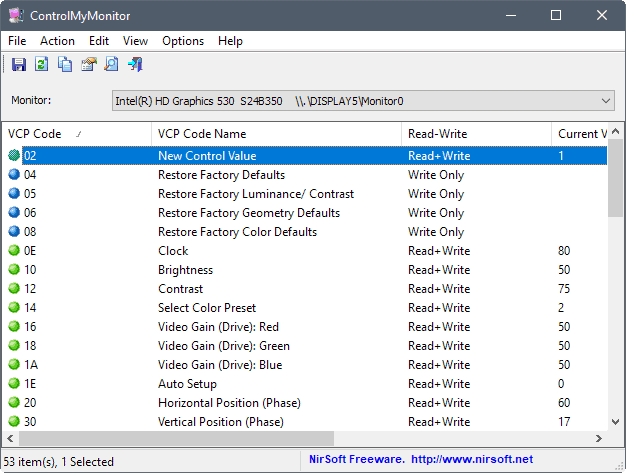
ControlMyMonitor is a free, portable NirSoft tool for Windows Vista through Windows 11 that reads and changes your monitor's hardware settings over DDC/CI. It shows every VCP feature the display exposes, such as brightness, contrast, color gain, input source and power, and lets you edit them from a table or from the command line, so you can script monitor changes instead of pressing the buttons on the bezel.
This guide covers what ControlMyMonitor needs, how to use the window, the command-line options with syntax from the official documentation, the most useful VCP codes and how to fix the common DDC/CI errors.
What ControlMyMonitor does
ControlMyMonitor is a monitor control utility that talks to the display itself, not to Windows display settings. Monitors that support DDC/CI (Display Data Channel Command Interface) accept commands over the video cable, and each adjustable setting has a VCP (Virtual Control Panel) code. ControlMyMonitor lists those codes, their current values and their limits, and writes new values back to the monitor.
That makes it different from tools that only dim the image with an overlay. A change made with ControlMyMonitor is the same as changing the setting in the monitor's on-screen menu: brightness, contrast, sharpness, red, green and blue balance, OSD language or the active input port, depending on what your model exposes.
According to NirSoft's ControlMyMonitor page, the program is freeware, needs no installation or extra DLLs, and runs on Windows Vista up to Windows 11. The only hardware requirement is a monitor and connection that support DDC/CI. The current release is version 1.43, which added a black background view option. You can also save all read/write settings to a text file and load them back later, which is handy for restoring a calibrated setup.
How to use ControlMyMonitor
You use ControlMyMonitor by selecting a monitor and editing the value of a VCP feature. The steps:
- Download ControlMyMonitor.zip from the official NirSoft page (a separate 64-bit download is linked there too) and extract it to any folder or a USB drive.
- Run ControlMyMonitor.exe.
- Pick your display in the combo box below the toolbar. Reading all values can take a few seconds.
- Double-click a row, or select it and press F6, and enter the new value. Values must stay within the maximum shown for that feature.
- Watch the monitor: changes apply immediately. Brightness (VCP code 10) is the easiest one to test.
For quick adjustments, use Increase Value and Decrease Value in the Action menu, or hold Ctrl and turn the mouse wheel (configurable under Options > Change Value With Mouse Wheel). Useful shortcuts are F5 to refresh values, Ctrl+F5 to refresh the monitor list, Ctrl+M to copy the monitor strings you need for commands, Shift+Ctrl+S to save all items and F9 for Advanced Options. File > Save Monitor Config and Load Monitor Config store and restore the writable settings.
ControlMyMonitor command-line options
ControlMyMonitor command-line options let you change monitor settings from scripts, shortcuts or Task Scheduler. Each command takes a monitor string: Primary, Secondary, a device name such as "\\.\DISPLAY1\Monitor0", a serial number, a monitor name, a monitor ID or a short monitor ID. Press Ctrl+M in the program to copy them; the string you use must be unique among your connected monitors.
| Command | What it does |
|---|---|
| /SetValue Monitor VCP Value | Sets an absolute value |
| /SetValueIfNeeded Monitor VCP Value | Writes only if the current value differs |
| /ChangeValue Monitor VCP Value | Changes a value relatively, for example -5 or 5 |
| /SwitchValue Monitor VCP V1 V2 | Toggles or cycles between two or more values |
| /GetValue Monitor VCP | Returns the current value as the errorlevel |
| /TurnOn, /TurnOff, /SwitchOffOn Monitor | Power control |
| /SaveConfig, /LoadConfig File Monitor | Saves or loads the writable settings |
| /scomma, /stab, /sjson and others | Exports current values to a file; an empty filename "" writes to stdout |
| /Wait Milliseconds | Pauses between chained commands |
Examples from the official documentation:
- Set brightness of the primary monitor to 70: ControlMyMonitor.exe /SetValue Primary 10 70
- Increase brightness of the secondary monitor by 5: ControlMyMonitor.exe /ChangeValue Secondary 10 5
- Lower contrast by 5: ControlMyMonitor.exe /ChangeValue "\\.\DISPLAY1\Monitor0" 12 -5
- Switch the input source: ControlMyMonitor.exe /SetValue "\\.\DISPLAY3\Monitor0" 60 3
- Toggle power on and off: ControlMyMonitor.exe /SwitchValue "\\.\DISPLAY1\Monitor0" D6 1 5
- Turn a monitor off: ControlMyMonitor.exe /TurnOff "\\.\DISPLAY3\Monitor0"
Several commands can be chained on one line, with /Wait between them if the monitor needs time to react.
Common VCP codes
VCP codes are the hexadecimal IDs ControlMyMonitor uses for each monitor setting. The codes below are the ones NirSoft documents; what values each accepts depends on your monitor, so read the current and maximum value in the program first.
| VCP code | Setting | Notes |
|---|---|---|
| 10 | Brightness | Usually 0 to 100 |
| 12 | Contrast | Usually 0 to 100 |
| 60 | Input Select | Values are model specific; see the option below |
| D6 | Power mode | 1 is on, 5 is off (4 on some monitors) |
| 04 | Restore factory defaults | Write-only; set to 1 to trigger |
Input switching is the code that most often misbehaves. If code 60 reports odd values, ControlMyMonitor offers an "Input Select - Use Only One Byte" option in the Options menu, added in version 1.41 for monitors that use only the first byte. Write the current value down before you experiment so you can return to a known state, and be careful with factory reset, which discards your on-screen menu settings.
Fixing ControlMyMonitor errors
Most ControlMyMonitor problems are DDC/CI connection problems rather than bugs in the program. NirSoft notes that errors starting with 0xc02625, such as 0xc0262582 or 0xc0262583, combined with an empty main window, mean Windows cannot reach the monitor over DDC/CI.
Work through this checklist:
- Enable DDC/CI in the monitor's on-screen menu; many models ship with it off or hide it under system settings.
- Update the graphics driver.
- Try another cable or port (HDMI, DisplayPort, DVI) and connect directly, without a KVM switch, dock or adapter in between.
- On AMD graphics, "Error 87: The Parameter is incorrect" is caused by an AMD driver bug, according to a January 2026 notice on the NirSoft page; roll back to the previous driver version until AMD releases a fix.
- If some values fail to load, open Advanced Options (F9) and use the loading mode and retry options added in version 1.40.
Built-in laptop screens generally do not expose DDC/CI, so control them with the Windows brightness slider instead.
Alternatives to ControlMyMonitor
ControlMyMonitor suits users who want full access to every VCP code and scripting. If you only want a brightness and contrast slider in the system tray, ClickMonitorDDC covers that with a simpler interface. If your monitor does not support DDC/CI at all, a software overlay such as the Dimmer screen dimmer darkens the picture without touching hardware settings. To watch temperatures and other sensor data rather than display settings, use Libre Hardware Monitor.
FAQ
Is ControlMyMonitor safe?
ControlMyMonitor is freeware from NirSoft (Nir Sofer) and is best downloaded from the official nirsoft.net page. It only changes settings the monitor itself allows, but use factory reset (code 04) with care.
Does ControlMyMonitor need installation?
No. It is a portable program: extract the ZIP and run ControlMyMonitor.exe from any folder or USB drive.
Can ControlMyMonitor read a value for use in a script?
Yes. /GetValue returns the current value as the errorlevel, and the export options such as /scomma "" write all values to stdout for parsing.
Related: ClickMonitorDDC brightness control, NirSoft LastActivityView

The tool shows more settings on an older monitor than on a newer monitor. Quite weird.
I wonder if this app does anything more than the ”Picture” settings already do? I use a 1080p 24” TV (only cost $100 U.S.) as a monitor (which is pretty cool as I can push a couple buttons on the remote & instantly be watching OTA programs), & the fine-tuning seems pretty complete.
Mike, the point is to be able to change those settings via scripts, not just from the OSD.
Thanks a lot !
Yes, thank you! I don’t say that enough on here.
And one more loaded.
And one more THANK YOU MARTIN !