Link Shell Extension: Create Hard Links, Junctions and Symbolic Links in Explorer
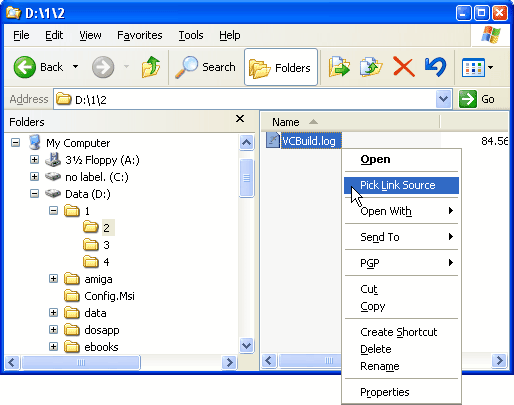
Link Shell Extension (LSE) is a free Windows Explorer add-on by Hermann Schinagl that creates hard links, junctions, symbolic links and volume mount points from the right-click menu. You right-click a file or folder, choose Pick Link Source, then right-click the destination and choose Drop As plus the link type. It works on NTFS drives, needs administrator rights to install, and the current release is version 3.9.3.5.
This guide explains what each link type does, how to install LSE and make your first link, how to find the menu on Windows 11, and what the extra copy modes such as Smart Copy and DeLorean Copy are for.

What Link Shell Extension does
Link Shell Extension adds NTFS link creation to Windows Explorer, so you no longer need the mklink command for everyday links. A link lets one file or folder appear in more than one place while the data exists only once on disk. The classic use case is moving a large folder (a game library, a project archive, a cache) to another drive and leaving a junction at the old path, so programs that expect the original location keep working.
LSE is a shell extension: a component that plugs into Explorer and adds commands to its menus and icons. It also adds overlay icons so you can tell links apart from normal files:
- Hard links show a red arrow on the icon.
- Junctions show a small chain symbol.
- Symbolic links show a light green arrow.
A link created by LSE is not the same as a Windows shortcut. A shortcut (a .lnk file, which Windows calls a shell link) is a small file that only Explorer and programs that read .lnk files understand. Hard links, junctions and symbolic links are handled by the NTFS file system itself, so every program sees the linked file or folder as if it were really there.
Hard link, junction or symbolic link: which one to pick
The right link type depends on whether the source is a file or a folder and whether it lives on the same drive. LSE picks a sensible default (files become hard links, folders become junctions, volumes become mount points), and the Drop As submenu offers the alternatives. Microsoft's documentation on hard links and junctions sets the rules.
| Link type | Links to | Key limits |
|---|---|---|
| Hard link | Files only | Same volume only; the data stays until the last link is deleted |
| Junction | Folders | Can point to another local drive, not to a mapped network drive |
| Symbolic link | Files or folders | Can use relative paths and network targets; may need elevation or Developer Mode |
| Volume mount point | Whole partitions | Mounts a volume inside an empty NTFS folder |
For moving a folder to a second drive, a junction is usually the simplest choice. For sharing one file between two folders on the same drive, use a hard link. Pick a symbolic link when you need relative paths or network targets.
How to install Link Shell Extension
Link Shell Extension installs from the developer's site or from the Windows package managers. Administrator rights are required either way.
- Open the Link Shell Extension homepage and download the installer that matches your Windows architecture.
- Run the installer and confirm the UAC prompt. If SmartScreen warns about the file, the developer advises choosing to install anyway; the installer is signed with a code signing certificate.
- The installer checks for the Microsoft Visual C++ runtime it needs and installs it if missing.
- Explorer restarts so the new menu entries and overlay icons load.
If you prefer the command line, run winget install HermannSchinagl.LinkShellExtension or, with Chocolatey, choco install linkshellextension. For a silent install, the installer accepts the /S switch. The developer's documentation names Windows 7, 8 and 10 and any Windows version with NTFS; it does not list Windows 11 by name, so try it on a test folder before you link anything important.
How to create a link with Link Shell Extension
Creating a link with Link Shell Extension takes two right-clicks: one to pick the source and one to drop the link.
- Right-click the file or folder you want to link to and choose Pick Link Source.
- Go to the folder where the link should appear.
- Right-click an empty area or the destination folder.
- Choose Drop HardLink for a file, or open Drop As and pick Junction, Symbolic Link or one of the copy modes for a folder.
- Check the new item: it should carry the matching overlay icon.
To cancel, right-click the destination background and choose Cancel Link Creation. You can also drag a source with the right mouse button and use HardLink Here or the Drop Here submenu when you release it.
On Windows 11, LSE commands live in the classic context menu. Click Show more options at the bottom of the right-click menu, hold Shift while right-clicking, or select the item and press Shift+F10 to open it directly.
Smart Copy, Smart Mirror and DeLorean Copy explained
The copy modes in Link Shell Extension copy or back up folder trees while keeping the links inside them intact, which a normal Explorer copy does not do.
- Smart Copy copies a folder structure and recreates its internal hard links, junctions and symbolic links at the destination instead of duplicating the data they point to.
- Smart Mirror synchronizes a source folder to a destination and deletes destination files that no longer exist in the source.
- DeLorean Copy creates incremental backups: unchanged files become hard links to the previous backup set, so each snapshot looks complete but only changed files use new space.
- Clone options (HardLink Clone, Symbolic Link Clone) rebuild a whole folder tree out of links.
- Smart Move lets you rename or move folders that contain junctions and symbolic links, and updates their targets.
Windows uses the same idea internally: the component store relies on hard links, which is why the WinSxS folder looks far larger than it really is. After a Smart Mirror run, a tool like Meld for folder comparison helps confirm that source and destination match.
Settings, network drives and limitations
Link Shell Extension comes with LSEConfig, a settings tool for overlay icons, menu behavior and remote features, plus the ln.exe command line companion for scripting the same operations.
Keep these limits in mind:
- NTFS required. FAT32 and exFAT drives cannot hold these links. ReFS supports symbolic links, junctions and mount points, and hard links from ReFS 3.5.
- Network drives. LSE can create remote links on SMB-mapped NTFS shares and UNC paths. If Explorer slows down when network drives are offline, turn off remote capabilities in LSEConfig.
- Symbolic link prompts. Creating symbolic links triggers UAC unless the user has the Create Symbolic Links privilege or Developer Mode is on.
- Missing overlay icons. Windows shows only a limited number of overlay handlers, so cloud sync apps can push LSE's arrows out. LSEConfig can change or disable them, and rebuilding the icon cache helps when icons look stale.
- Orphaned links. A junction is a one-way pointer. If you move or delete the target, the junction points nowhere.
FAQ
Is Link Shell Extension free?
Yes. Link Shell Extension is free to download and use, and the developer accepts donations on the homepage.
How do I uninstall Link Shell Extension?
Remove it from Settings > Apps or run its uninstaller from the installation folder. Explorer restarts afterwards to unload the extension; links you already created stay in place because they belong to the file system.
Can I create the same links without installing anything?
Yes. The built-in mklink command creates symbolic links by default, directory symbolic links with /d, hard links with /h and junctions with /j. LSE adds the Explorer menu, overlay icons and the copy modes on top.
Does deleting a link delete the original data?
Deleting a junction or symbolic link removes only the link. Deleting a hard link removes one name for the file, and the data is freed only when the last hard link is gone. Deleting files inside a junction folder deletes them at the original location.
Related: show full folder thumbnails in Windows 11, open File Explorer to the Downloads folder

Leave a Reply