WizTree for Windows: Fast Disk Space Analyzer and Large File Finder
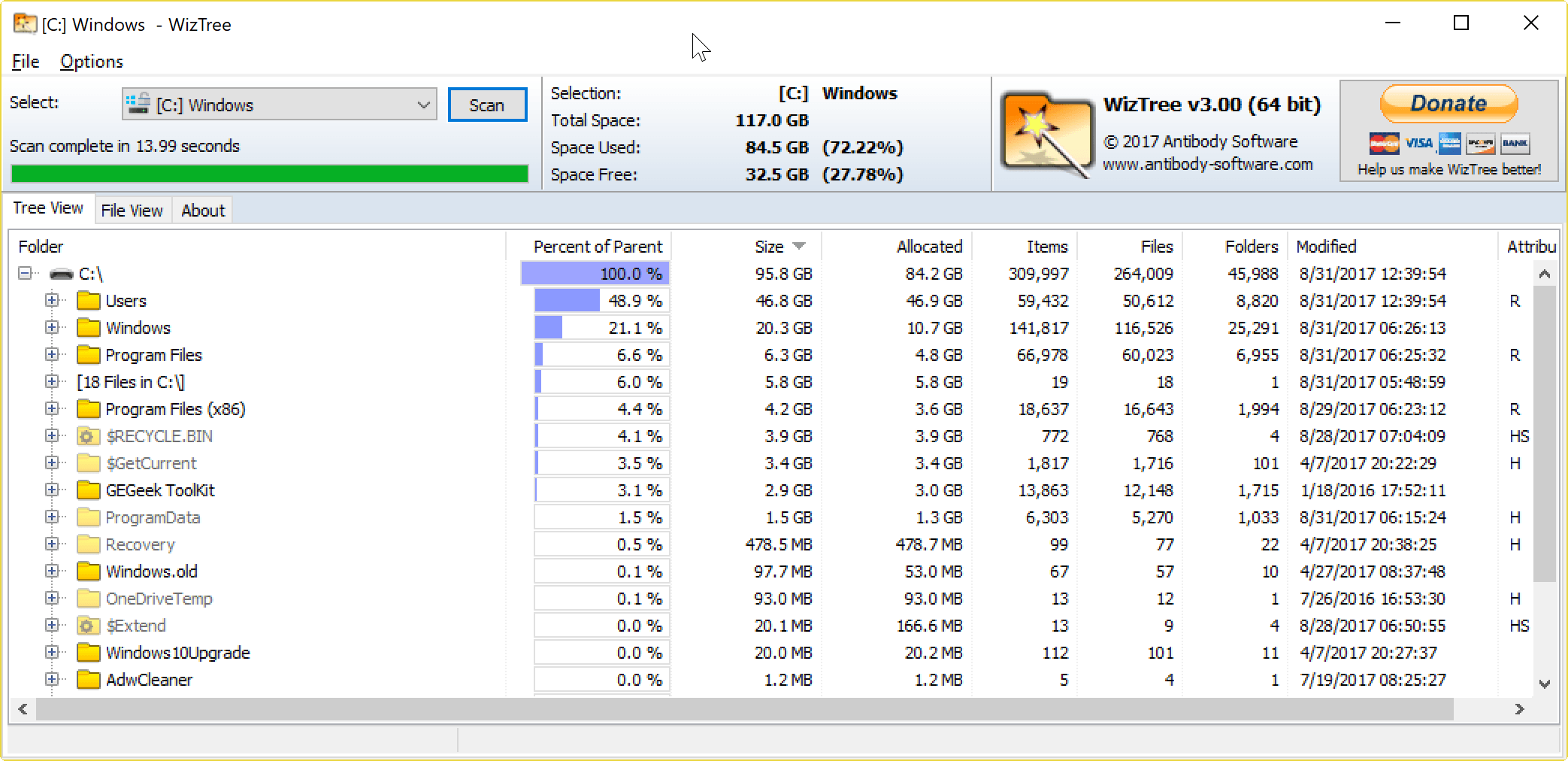
WizTree is a disk space analyzer for Windows, free for personal use, that finds the largest files and folders on a drive in seconds. On NTFS drives it reads the Master File Table directly instead of walking every folder, which makes it much faster than Explorer or classic analyzers. Run it as administrator, pick a drive, click Scan, and sort the results by size to see what is filling up your disk.
This guide covers what WizTree does, how its fast scan works, how to find and remove large files, the filter syntax, duplicates and CSV export, plus download options, licensing and the new macOS version.
What is WizTree?
WizTree is a disk space analyzer from Antibody Software that shows which files and folders use the most storage on Windows drives. Results appear in three ways: a Tree View that lists folders by size, a File View that lists individual files, and a treemap that draws every file as a block sized by its disk usage, so large items stand out at a glance.
The program is free for personal use, runs on Windows 11, 10, 8, 7, Vista, XP and Windows Server 2003 or later, and comes as an installer or a portable zip. It is one of the tools on our list of the best Windows software, and Ghacks has followed it since we first used it to find out which files use the most space on Windows in 2012.
Typical uses:
- Find forgotten videos, ISO images, virtual machine disks and game installs that fill a drive.
- Check how much space system folders such as WinSxS, the hibernation file or restore points take.
- Spot duplicate downloads and old backups before buying a bigger SSD.
- Export a full file list to CSV for audits or scripted reports.
Why WizTree scans so fast
WizTree is fast because it reads the NTFS Master File Table (MFT), the index that lists every file on the drive, in one pass instead of asking Windows for each folder separately. The developer claims this makes it 46 times faster than WinDirStat.
The fast MFT scan needs administrator rights. The WizTree FAQ states that high speed NTFS scanning is only possible when the program runs elevated, which is why WizTree asks for admin rights at launch by default. Without them, or on non-NTFS and network drives, it falls back to a slower folder-by-folder scan. Version 4.28 made that fallback up to twice as fast in some cases.
WizTree also counts NTFS hard links once, so files that appear in several places (common in the Windows component store) do not inflate the totals. Its "Allocated" column shows the space a file really occupies on disk (a multiple of the cluster size), which is why compressed files often show a smaller allocated size than file size, and why the total can be slightly lower than the Used space Windows reports: some NTFS metadata is not stored as files.
How to find large files with WizTree
To find large files with WizTree, scan the drive and open the File View tab, which lists files sorted by size. Follow these steps:
- Download WizTree from the official site and start it (accept the administrator prompt for the fast scan).
- Select a drive in the drop-down at the top, or pick a single folder to scan.
- Click Scan. The Tree View fills with folders sorted by size, and the treemap appears at the bottom.
- Expand the largest folders in Tree View to drill down, or switch to File View to see the biggest individual files across the whole drive.
- Click a block in the treemap to jump to that file in the list; double-click to zoom into a folder.
- Right-click any entry to open its location in Explorer, copy the path or open a command prompt there.
If one folder looks suspiciously large, check what it is before deleting anything. Ghacks guides on analyzing the WinSxS folder and on Chrome's File System folder explain two common space hogs that should be cleaned with the right tool rather than by hand.
Deleting files and finding duplicates in WizTree
WizTree can delete files directly: select files or folders in Tree View or File View and press the Delete key. Deleted items stay marked in the results, and since version 4.15 they get a red outline in the treemap, so you do not need to rescan to see what you have already removed. Version 4.29 added renaming of files and folders, which can be turned off under Tweaks.
The duplicate finder, added in WizTree 4.19, sits in the File View as a "duplicate files" drop-down plus a "duplicates only" checkbox. It matches files by name and size, or name, size and date. It does not compare file contents, so two files flagged as duplicates are not guaranteed to be identical. Open or hash both copies before you delete one.
Safe deletion checklist:
- Delete your own data (downloads, videos, old installers, archives) first.
- Leave Windows, Program Files and ProgramData contents alone; uninstall programs through Settings instead.
- Use Disk Cleanup or Storage Sense for Windows Update leftovers and the component store.
- Keep a backup of anything you are unsure about.
WizTree filter syntax and CSV export
WizTree's File Search Filter box in File View accepts wildcards, size and date operators; type a filter and click Apply Filter. By default the view shows the first 1,000 results, which you can raise with the "Max files to display" setting. Examples from the official WizTree guide:
| Filter | What it finds |
|---|---|
| *.mp4|*.mkv | MP4 or MKV files (the pipe means OR, no spaces) |
| *.mp3 dance | MP3 files with "dance" in the name (a space means AND) |
| >=500mb <=1gb | Files between 500 MB and 1 GB |
| >=today-7 | Files modified in the last 7 days |
| !windows | Everything that does not match "windows" |
| =folder | Folders only (=file shows files only) |
| pathlen>200 | Paths longer than 200 characters |
To export results, press Ctrl+Alt+E or right-click and choose "Export to CSV file". For scripts, WizTree supports command line export, for example wiztree64.exe "C:" /export="C:\temp\export%d_%t.csv" /admin=1, with optional /filter, /filterexclude and /sortby parameters.
WizTree download, versions and license
WizTree is available from the official download page as an installer or a portable zip with 32-bit and 64-bit builds. Windows users can also install it with winget (winget install -e --id AntibodySoftware.WizTree). WizTree 4.33 is the current version, released on September 16, 2026; Windows on Arm devices are supported through Prism emulation, confirmed in version 4.32.
The same release introduced WizTreeMac 1.00 for macOS 12 Monterey or later (Universal build for Apple Silicon and Intel), with most WizTree 4.33 features and CSV files that can be opened in the Windows version.
Personal use is free. A supporter code removes the Donate button and covers commercial use; the supporter code page lists these prices:
| License | Price (USD) |
|---|---|
| Individual | $25 |
| Micro Business (up to 5 staff) | $100 |
| Small Business (up to 20 staff) | $200 |
| Medium Business (up to 50 staff) | $350 |
| Large Business (up to 100 staff) | $500 |
| Enterprise (unlimited, single site) | $750 |
| Enterprise (unlimited, multi site) | $1,800 |
History: WizTree 3.0, released on August 31, 2017, added the first 64-bit build for very large MFTs, NTFS hard link handling and the Allocated column. It followed WizTree 2.0, which brought support for all drive types and single folder scans.
WizTree 4.00, released in June 2021, added scanning of several drives and folders at once (choose Select Multiple in the drive drop-down), highlighting of matching text in file search results and faster searches. The same release moved the project from wiztreefree.com to diskanalyzer.com and introduced paid licenses for commercial users, priced by the number of users, while the program stayed free for home users.
FAQ
Is WizTree safe to use?
A scan does not change your files; deletions and renames only happen when you trigger them. Download WizTree from diskanalyzer.com or install it with winget to avoid repackaged copies from third-party download sites.
Where does WizTree store its settings?
The installed version keeps its settings in WizTree3.ini under %appdata%\WizTree3. The portable version stores WizTree3.ini in the same folder as the WizTree executable.
How do I stop WizTree from asking for administrator rights?
Clear the "Always Run as Administrator" option in WizTree's Options. The program then starts without elevation, but scans use the slower method instead of reading the MFT.
Related: find which files use the most space on Windows, analyze the WinSxS folder, fix "optimization not available" in Optimize Drives

I should have clarified, that I was scanning a 1TB drive with millions of files. TreeSize starts showing data from the beginning, but Wiztree takes a fair while to do a full scan before showing the results.
I really like the live deletions of Wiztree!
I found TreeSize Free to be a lot faster (to at least start showing data). I think wiztree waits til it’s finished scanning first, before showing any data which can take a long time.
I also found that the RAM usage of Wiztree also ballooned pretty quickly, well past half a GB within a minute of scanning (a massive drive), whereas TreeSize Free stayed under 150MB of RAM scanning the same drive.
I like that wiztree can scan network drives, this is a great feature that TreeSize makes you pay for.
Everything is quick and it lets you find ANY file on disk.
I still prefer Treesize Free which integrates into Explorer, but WizTree is quick.
WizTree integrates into Explorer as well.
FYI — Just like in Explorer, delete (either pressing the key or the context menu item) is just “move to recycle”, not permanent delete. Shift-Delete is required for permanent delete. Also, undoing a delete, or restoring from the recycle bin immediately after hitting delete, does not remove the red crossout of the filename shown in WizTree.