How to Check Hard Drive Health in Windows (HD Tune and Built-in Tools)
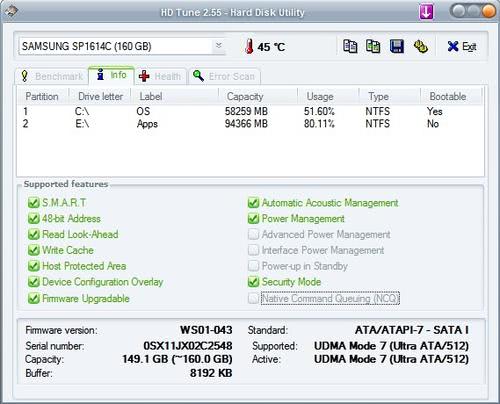
To check hard drive health in Windows, read the drive's S.M.A.R.T. data. The quickest built-in route is PowerShell: run Get-PhysicalDisk and look at the HealthStatus column (Healthy, Warning, Unhealthy or Unknown). NVMe SSDs also show estimated remaining life and temperature under Settings > System > Storage. For HDDs and SATA SSDs, a S.M.A.R.T. reader such as HD Tune or CrystalDiskInfo gives the full attribute list.
This guide covers the built-in Windows checks, what each one can and cannot tell you, how to use HD Tune to read health and scan for errors, and which warning signs mean you should back up and replace the drive.
How to check drive health in Windows Settings
Windows Settings shows drive health only for NVMe SSDs; it does not monitor SATA SSDs or hard disk drives, according to Microsoft's storage warning help page. If your PC boots from an NVMe drive, this is the fastest check:
- Open Start > Settings > System > Storage.
- Select Advanced storage settings, then Disks & volumes.
- Select the drive and click Properties.
- Read the Drive health section.
The section lists three values. Estimated remaining life is the manufacturer's prediction of how much rated life is left. Available spare is the share of reserve flash blocks still unused, from 0 to 100 percent. Temperature is the device temperature in degrees Celsius.
When the drive reports a problem, Windows shows a critical warning that reliability is degraded and tells you to back up your data. Microsoft notes that an estimated remaining life below 0 percent does not automatically mean the drive will fail, but a warning is the moment to make a fresh backup. If the Drive health section is missing, the drive is not NVMe or does not report the data, so use one of the methods below.
How to check hard drive health with PowerShell
PowerShell reads the health state that Windows' storage stack reports for every physical disk, including HDDs and SATA SSDs. Open Terminal or PowerShell as administrator and run:
- Get-PhysicalDisk
- Get-PhysicalDisk | Get-StorageReliabilityCounter | Format-List
The first command lists each drive with its OperationalStatus and HealthStatus. Microsoft documents four HealthStatus values: Healthy, Warning, Unhealthy and Unknown. Anything other than Healthy deserves a closer look.
The second command pipes the disks to Get-StorageReliabilityCounter, which returns counters such as Temperature, TemperatureMax, Wear, ReadErrorsTotal, ReadErrorsUncorrected, WriteErrorsUncorrected and PowerOnHours. Not every drive fills every field, so a blank Wear value usually means the drive does not report it, not that it is new.
PowerShell is a good first check because it needs no download, but it summarizes. It will not show the raw S.M.A.R.T. attributes, such as reallocated or pending sectors, that most reliably predict a failing hard drive. For those, use a dedicated tool.
How to check hard drive health with HD Tune
HD Tune is a Windows utility that reads a drive's S.M.A.R.T. values, shows its temperature and details, benchmarks read speed and scans the surface for damaged blocks. It has four main tabs:
- Health: lists every S.M.A.R.T. attribute with current, worst and threshold values, plus an overall status. A failing attribute, or a worst value close to its threshold, points to trouble.
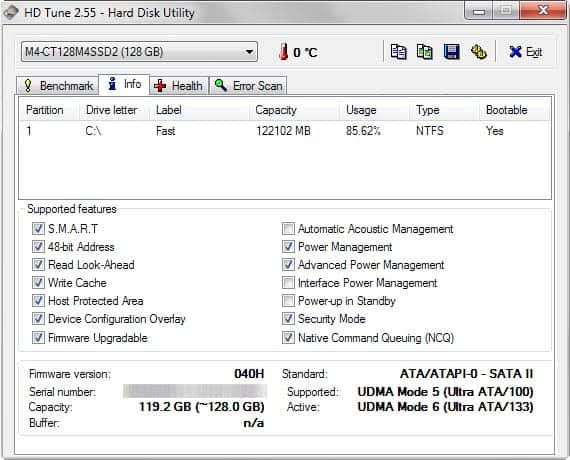
- Info: shows partitions, capacity, firmware version, serial number, supported features and the active interface, which helps you spot a drive running on a slower link than it supports.
- Error Scan: reads the whole drive and shows any damaged blocks it finds.
- Benchmark: measures read transfer rate and access time, useful for comparing the drive against itself over time.
To check health, install HD Tune from the official HD Tune download page, select the drive from the drop-down at the top, open the Health tab and read the status line and attribute list. Run Error Scan afterwards if you suspect bad sectors; a full scan of a large hard drive takes a long time.
HD Tune free vs HD Tune Pro
The free HD Tune is version 2.55 from February 2008, licensed for personal use, and its developer lists support only up to Windows 7. HD Tune Pro is the maintained edition: version 6.10 was released in October 2024, it supports 64-bit Windows 7, 8, 10 and 11, and NVMe health support arrived in version 6.00. Pro costs $29.95 (24.95 euros) per single-user license after a 14-day trial.
| Feature | HD Tune (free) | HD Tune Pro |
|---|---|---|
| S.M.A.R.T. health, drive info, error scan | Yes | Yes |
| Read benchmark | Yes | Yes |
| Write benchmark, cache and file tests | No | Yes |
| External drive health and temperature | No | Yes |
| S.M.A.R.T. self-test, disk monitor, secure erase | No | Yes |
| Health check of multiple drives | No | Yes |
On a current Windows 10 or 11 PC with an NVMe drive, the free version is the wrong tool: it predates NVMe and is no longer updated. Use Pro, or a maintained free alternative.
Free alternatives: CrystalDiskInfo and vendor tools
CrystalDiskInfo is a popular free S.M.A.R.T. reader for Windows that is still actively maintained (version 9.9.4 was released in November 2026). It supports HDDs, SATA SSDs and NVMe drives (NVMe needs Windows 10 or later), has partial USB support, and runs on x86, x64 and ARM64 from the developer's site. It shows a health rating per drive, temperature, power-on hours and the full attribute table.
Drive makers also ship their own utilities that read health, update firmware and run the manufacturer's diagnostics. Crucial owners can use Crucial Storage Executive; other brands offer similar tools on their support sites. For live temperature monitoring next to CPU and GPU sensors, Libre Hardware Monitor is an open-source option.
On a Mac, Disk Utility's First Aid checks the formatting and directory structure of a drive. If it reports that the disk is about to fail, Apple advises backing up and replacing it, since it cannot be repaired.
Which S.M.A.R.T. values mean a drive is failing
A drive is likely failing when its overall status changes to Caution, Warning or Bad, or when attributes that count damaged media start rising. Watch these most closely:
- Reallocated sectors count: sectors the drive has replaced with spares. Any non-zero raw value that keeps growing is a warning.
- Current pending sector count: unstable sectors waiting to be remapped. These often mean unreadable data.
- Uncorrectable sector count and reported uncorrectable errors: read errors the drive could not fix.
- Percentage used or available spare (NVMe and SSDs): how much rated endurance is consumed and how many spare blocks remain.
- Temperature: sustained heat above the maker's rated range shortens life, so check airflow.
Compare readings over weeks, not once. A stable value is far less worrying than one that climbs between checks. Clicking or grinding noises, files that suddenly fail to open and long freezes when accessing the drive are physical signs that back up the numbers.
Is chkdsk a drive health check?
Chkdsk is a file system check, not a hardware health check. Microsoft's chkdsk reference explains that running it without parameters only reports status, /f fixes logical file system errors, and /r also locates bad sectors and recovers readable data. It does not read S.M.A.R.T. data, and on a drive with failing hardware it can behave unpredictably.
Run S.M.A.R.T. checks first. If the drive reports reallocated or pending sectors, copy your important files to another disk before you run chkdsk /r, because a long sector scan puts extra load on hardware that is already weak. Run chkdsk from Command Prompt or Terminal opened as administrator. If Windows' own drive maintenance misbehaves, see how to fix "optimization not available" in Optimize Drives.
FAQ
How often should I check hard drive health?
Once a month is a sensible routine for most PCs, and immediately after crashes, freezes or new noises. The trend between checks matters more than a single reading.
Can a drive fail even if S.M.A.R.T. says it is healthy?
Yes. S.M.A.R.T. catches gradual wear well but cannot predict sudden electronic or controller failures, so regular backups remain the real protection.
Does Windows warn me before a drive fails?
For NVMe SSDs, Windows shows a critical storage warning when the drive reports degraded reliability. For hard drives and SATA SSDs there is no comparable Settings alert, so check them with PowerShell or a S.M.A.R.T. tool.
Related: managing Crucial SSDs with Storage Executive, Libre Hardware Monitor sensor overview, HP USB Disk Storage Format Tool

” If the active transfer mode does not equal the supported one you need to check on that because your hard drives are not running at top speeds then.”
Disagree:
http://www.tomshardware.co.uk/forum/page-185797_14_0.html
I use it sometimes to check the temperature of my HDD in summer. Also error scanning is a very useful feature to test the damaged harddisks.