India asks Apple, Google and Android OEMs to preload Sanchar Saathi app on all phones
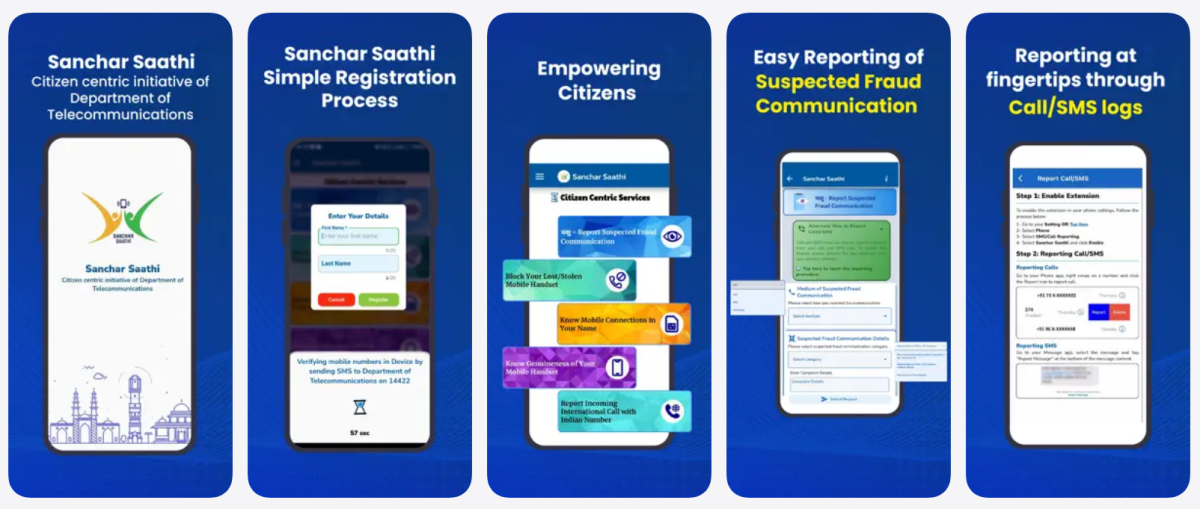
The Indian government has issued a directive to manufacturers to pre-install the Sanchar Saathi app on all mobile phones in the Country. Here's what you need to know about it.
What's the Sanchar Saathi app? The word Sanchar has several definitions in Hindi, one of which means Communication. Saathi means friend, or companion.
Sanchar Saathi isn't a new app, it was released for Android and iOS in January 2025 by the Department of Telecommunications (DoT). It was designed to curb the misuse of telecom resources for cyber frauds and help cybersecurity. It helps users report fraud communications, lost/ stolen mobile handsets, verify the authenticity of a mobile phone using the IMEI number, check the mobile connections that are in their name, view trusted contact details of banks/ financial institutions.
In a press note in September 2025, the DoT revealed that the app had been helpful in blocking over 37.28 lakh (3.728 million) stolen/lost mobile devices, and that it had been used to trace and recover over 22.76 lakh (2.276 million) devices from the Sanchar Saathi LIVE dashboard. It's basically India's version of Google's Find My Device, and Apple's Find My, these apps are pre-installed on Android mobile devices and iPhones respectively. I get frequent text messages from the Government about the app, and its uses. It's kind of annoying.
And now we come to what has happened. The DoT has issued directions to OEMs to pre-install the Sanchar Saathi app on all mobile phones sold in India, including those that are manufactured locally or imported to India. The app needs to be readily visible and accessible during the device's set up. Its functionalities cannot be disabled or restricted. OEMs will need to push the app through software updates for existing devices in India.
The press release says that these rules will help "safeguard the citizens from buying the non-genuine handsets, enabling easy reporting of suspected misuse of telecom resources". You can read the press release here.
Now, I'd like to see how this works. There are millions of phones that don't receive software updates, and stuck on older versions of Android.
Many news outlets that have reported that the app collects a lot of data, and it's a huge privacy risk. Could it be used for surveillance? I fully agree that having a Government app on your phone does raise questions about user's privacy.

Let's take a look at the app's listing on the iOS App Store and the Google Play Store, both of them say that no data is collected.

Here's the app's privacy policy.

The following permissions are used on Android devices
- Make & Manage phone calls: To detect mobile numbers in your phone.
- Send SMS: To complete registration by sending the SMS to DoT on 14422.
- Call/SMS Logs: To report any Call/SMS in facilities offered by Sanchar Saathi App.
- Photos & files: To upload the image of Call/SMS while reporting Call/SMS or report lost/stolen mobile handset.
- Camera: While scanning the barcode of IMEI to check its genuineness.
And here are the permissions used on iPhones.
- Photos & files: To upload the image of Call/SMS while reporting Call/SMS or report lost/stolen mobile handset.
- Camera: While scanning the barcode of IMEI to check its genuineness.
The privacy policy also states that the app will not automatically capture any personal information from the user without notifying them. The data is also not shared with third-parties, except those that are required by law enforcement agencies. That's probably required to trace lost phones, which is likely why they don't want users to uninstall or remove or disable the app.
I think it's a mistake to have made the Sanchar Saathi app mandatory on all devices. If the app is useful, people should be given the choice whether to install it or not.
Is it surprising? Age verification has become mandatory in many Countries. European nations want to implement Chat Control, which is basically a backdoor that lets Governments access your messages, photos, etc. to combat CSAM. What next?

The problem with governments around the world treating countries as a business and everyone living there as their personal property to make a small number of people incredibly wealthy, is nobody trusts these ar*eholes any more. Everything they do now seems to come from a place where they’re terrified the masses will turn on them – which will become a self-fulfilling prophecy if they keep going.
Phones already have “Find My” features that allow people to remotely block their phone. Mobile carriers also already have the ability to block mobile devices by IMEI – Amazon for example have a disclaimer on their website stating that “Amazon may report the relevant IMEI serial number in loss and theft databases to prevent its fraudulent use or resale”. Carriers also have the ability to track phones, as they know the distance of the device from the towers.
So why exactly would a government mandate a poorly conceived idea such as this, unless they have ulterior motives. For the app to prevent use of the phone when stolen, this government mandated app will require pretty extensive privileges and will be incredibly difficult to remove the app – as that would defeat the stated purpose. At some point they’ll almost certainly use this to install their own Certificate Authority Root Certificate so they can MITM all traffic from people’s devices. This is nothing more than a surveillance tool.
As for the claim about recovering stolen phones, are the Indian police so well funded that they’re getting warrants, then going round to phone thieves homes and recovering people’s individual $300 mobile phones.
This move by the Indian government is definitely going to spark a lot of discussion. Preloading the Sanchar Saathi app on all new phones could help users track lost devices and stay safer from mobile-related fraud, which is a good goal. But at the same time, mandatory preinstallation raises questions about user choice and how much control people should have over what comes on their devices. It will be interesting to see how Apple, Google, and other OEMs respond, and whether users will have the option to remove or disable the app easily.
I am not surprised this is happening and I think it will continue to happen and expand everywhere.
Europe says it needs to spy on people’s chat on the pretense of “terrorism” and “protecting the kids”, but it’s mostly just to spy on people.
I watched Linus Torvalds yesterday being a guest on Linus Tech Tips where they were building a Linux PC together and Torvalds said one thing about privacy that I really like:
“Be so uninteresting that nobody would want to spy on you.” This is in my opinion the best thing one can do for their privacy. Before this I never heard Torvalds speak and many things he said sounded very sensible.
Mandatory installation raises real privacy concerns — useful features aside, users should always have the right to choose.
I do not mind if it is preinstalled, if people could uninstall it with maybe 2 prompts. I am tech-savvy enough to know how to sideload apps safely and which preinstalled apps could be uninstalled. But I do not like mandatory stuff that can not be removed.
I bet this app will be used to access Government services and maybe healthcare and transportation services too because it will be the only app that will be allowed for those. However, for everything else, people will use apps that they used before. Even in democratic countries, we age going into an age when only one app made by Government can access critical services.