Opera 120 is out with privacy-friendly fullpage translations and more
The developers of the Opera web browser have released Opera 120 to the public. The latest stable version of the web browser adds several features to the browser, including a natively integrated translation option. The update upgrades the core of the browser to the latest Chromium version next to that.
The update is available already and unmanaged Opera installations should receive it automatically. You can open Opera Menu > Update & Recovery to check for the update and get it installed as early as possible.
Built-in translate feature
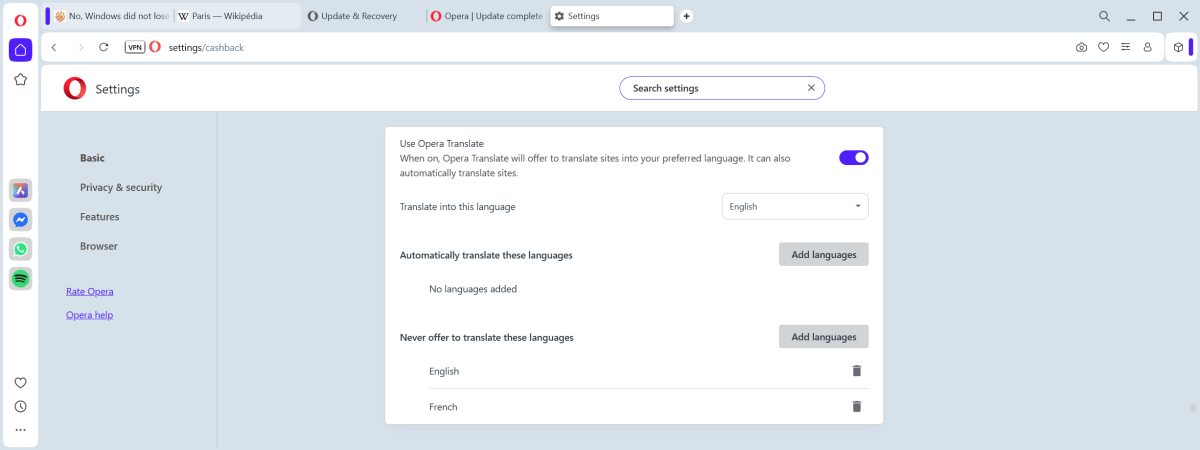
The big new feature in Opera 120 is translate functionality that the company has baked into the desktop version. Opera relies on the services of Lingvanex for that, which it says it is self-hosting on its own servers. This is not all that different from how Vivaldi has been offering translate functionality, as it is also powered by Lingvanex.
Opera says that the translate feature is hosted on its European-based servers, which are protected by some of the strictest privacy regulations. Information that is used for translating content is not being "sent to any third party" either, according to the announcement.
While not on par with Firefox-grade translations, which offers native built-in translation that does not need remote servers at all after downloading packs for languages, it is better than the translation features that Google or Microsoft have baked into their browsers.
Opera displays a translate icon in the main toolbar when you visit a foreign language webpage. It offers to translate the content into the desired language, a process that has been quick during tests.
You can turn it off in the settings, if you do not need it. There you also find options to translate select languages automatically and to never translate specific languages. Last but not least, you may set the default language that content should be translated to here as well. Opera says that the browser supports more than 40 different languages now.
Other improvements in Opera 120
What else is new?
Opera says that it has improved Split Screen mode in the browser. The mode enables you to display two open tabs side-by-side in the browser. These pairs can now also be part of Opera's Tab Island feature, which enables groups of tabs.
The developers have tweaked the display of icons when that mode is active furthermore. Opera says the right tab will show "Account, Easy Setup, Download, Extensions, and pinned player in toolbar" and that additional icons are shown when you hover over an open tab in split screen mode.
There is also a new user interface design for the password manager popup, which Opera says is much easier to see. You can check out the full changelog here.
Now You: do you use the Opera browser? What is your take on built-in translate functionality? Feel free to leave a comment down below.

Opera is such a beautiful browser, but for some reason I’ve never transitioned to it as my main browser.
Recent figures:
https://mspoweruser.com/opera-statistics/
“Initially released in 1995, Opera is one of the oldest and most successful web browsers in history.”
Opera is fully bloated with unuseful things that makes so difficult to make a simpler browsing.
I think it started fine, then having Presto made them a big problem and then moving to Blink was fine at first, but at this point I don’t know what’s going on in headquarters that they are now trying to bloat the browser with features, as well as releasing several other browsers. I think they won’t be able to maintain that many browsers and will have to abandon them at some point.
I think someone in there is trying to justify why they need to be kept employed by coming up with these crazy ideas.
Opera is since 2020 owned by a Chinese company: Kunlun Tech and is directly lead by Kunlun’s founder. Kunlun earns the majority of its money from gaming and advertizing and also operates a FinTech company called Opay in Nigeria.
Iirc Opera did position itself sometime ago as “the gaming browser”, didn’t they ?
So it should be rather obvious, what’s going on.
A small factcheck:
“Opera is since 2020 owned by a Chinese company: Kunlun Tech and is directly lead by Kunlun’s founder. Kunlun earns the majority of its money from gaming and advertizing and also operates a FinTech company called Opay in Nigeria.” FALSE
Opera has a chinese “shareholder” since 2016. The company’s stock was bought in Norway paid in NOK and is still headquatered in Oslo.
Opay’s ownership structure is a mix of founders, Opera Limited, international investors (primarily Chinese), and the management team, reflecting a blend of local and global influence aimed at promoting financial inclusion in Africa.
“So it should be rather obvious, what’s going on.” ?
If you do not even know the correct dates…. why should I belive you?
…and Brave positioned itself as the crypto/fintech browser, what’s the problem with that?