Boston Dynamics Is Training Atlas to Handle Real Factory Tasks With AI

Boston Dynamics is moving its humanoid robot Atlas out of controlled demos and into real industrial environments. The company is now testing AI-powered versions of Atlas inside factories, with early trials focused on repetitive material-handling work.
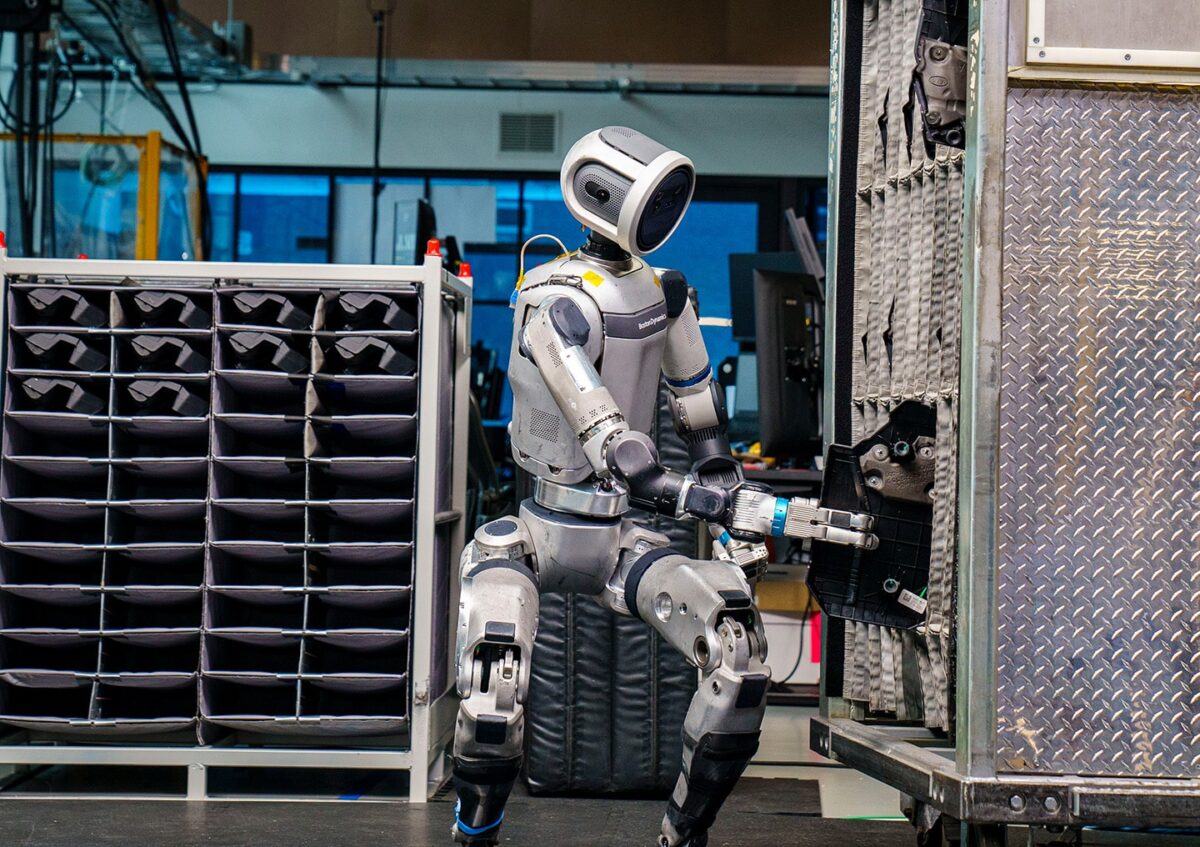
With backing from Hyundai, which owns a majority stake in Boston Dynamics, Atlas has already been deployed in limited trials at Hyundai's new Georgia manufacturing plant. There, the humanoid robot practiced autonomously sorting roof racks for the assembly line, a task normally handled by human workers.
This marks a shift from spectacle to practicality. Atlas is no longer just running, jumping, or performing choreographed routines. It is being trained to do useful work.
From pre-programmed moves to learned behavior
Earlier versions of Atlas relied heavily on manually coded motion algorithms. The current generation looks very different. It is fully electric, slimmer, and powered by AI systems running on high-end compute hardware.
Instead of scripting every movement, Boston Dynamics now trains Atlas using machine learning. Engineers teach the robot tasks through demonstrations rather than explicit instructions.
One method involves supervised learning using virtual reality. A human operator wears a VR headset and directly controls Atlas' arms and hands, guiding it through each step of a task. That interaction generates training data, which is then used to teach Atlas how to repeat the task autonomously.
Another technique uses motion capture suits. Human movements are recorded and translated to Atlas' very different body structure. The robot does not copy motions directly but learns how to achieve the same outcome using its own mechanics.
Training thousands of robots at once
Much of Atlas' learning happens in simulation. Boston Dynamics runs thousands of digital Atlas models in parallel, exposing them to different conditions such as uneven floors, limited mobility, or mechanical resistance.
These simulations allow the system to test variations quickly and identify stable movement strategies. Once a skill is learned in simulation, it is uploaded to the control system used by every physical Atlas robot.
That approach means improvements scale instantly. Training one Atlas effectively trains them all.
Useful, but far from general-purpose
Atlas can now run, crawl, lift, sort objects, and perform coordinated movements that were considered unrealistic for humanoid robots only a few years ago. Still, Boston Dynamics is clear about the limitations.
The robot cannot yet perform many everyday tasks humans take for granted, such as dressing, cooking, or handling fragile objects reliably. These remain difficult problems due to the complexity of human environments and fine motor control.
The company's focus is narrower: repetitive, physically demanding work in structured environments like factories and warehouses.

Factory work comes first
The Hyundai trial highlights where humanoid robots are most likely to appear first. Assembly-line logistics, material handling, and physically taxing jobs are well-defined and repeatable, making them ideal early use cases.
Boston Dynamics' leadership has framed this as a way to reduce human exposure to dangerous or exhausting work rather than replace entire roles. Robots like Atlas still require human oversight, maintenance, and training.
That also limits how autonomous they can be in the near term.
No Terminator scenario
Despite growing concern about AI and automation, Boston Dynamics downplays fears of runaway humanoids. The company describes the reality as the opposite: robots are difficult to train, fragile in unexpected situations, and heavily dependent on human input.
Atlas represents progress, but also the current ceiling of what AI-powered humanoids can do outside controlled environments.
For now, the goal is not general-purpose robots roaming freely, but specialized machines capable of doing one job well and safely.
Atlas' factory trials suggest that phase is already underway.
Do you believe that robots can replace humans in manual work? yes/no

Leave a Reply