Researchers Build Autonomous Robots Smaller Than a Grain of Salt
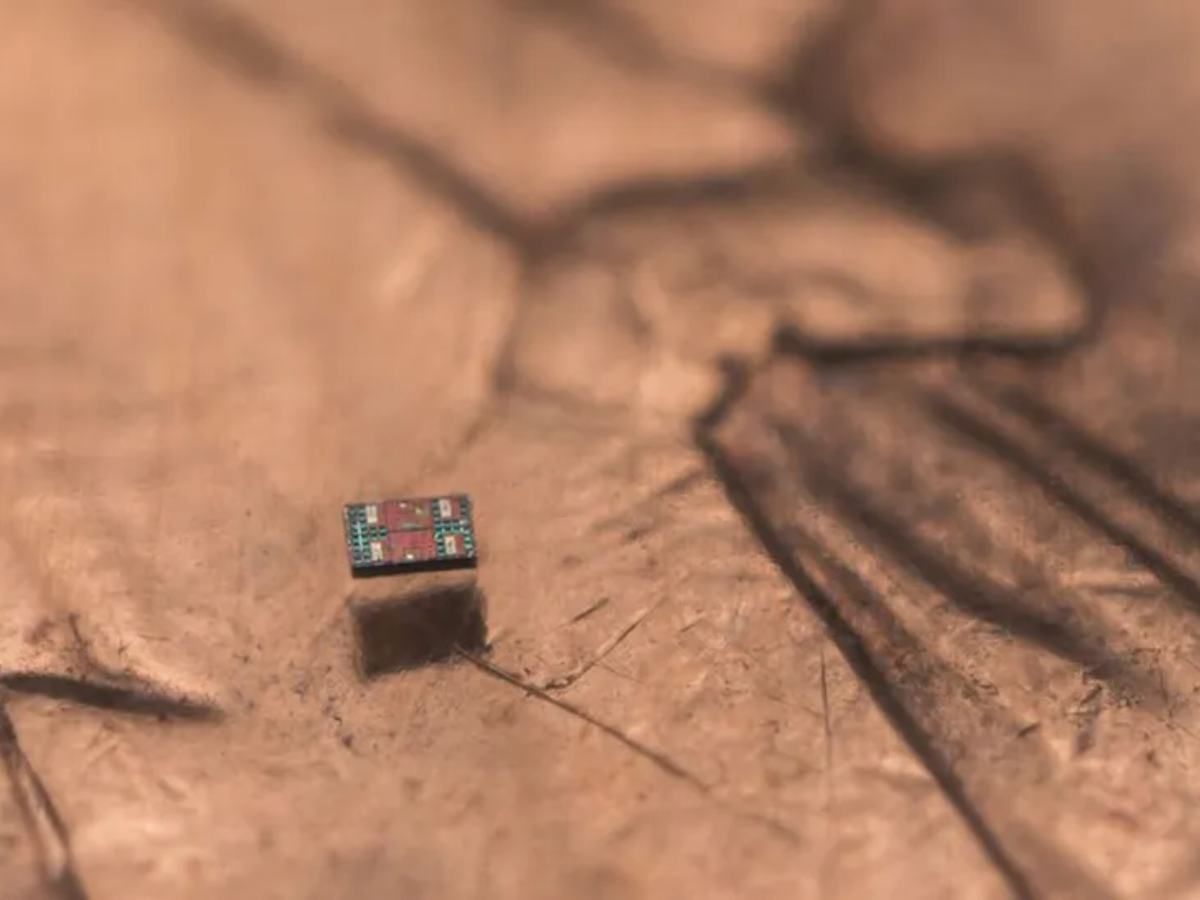
Researchers from University of Pennsylvania and University of Michigan have built what they describe as the world's smallest fully autonomous robots. The devices are small enough to operate at the scale of biological cells, measuring roughly 200 × 300 × 50 micrometers, about one-tenth the width of a millimeter.

Despite their size, the robots are self-contained. Each unit can move, sense its environment, perform basic computation, and respond without external control, tethers, or magnetic guidance. According to the researchers, the robots are also inexpensive to manufacture, costing around one cent per unit.
The work was led in part by Marc Miskin, an assistant professor of electrical and systems engineering, who noted that these robots are orders of magnitude smaller than previous micro-robotic systems. Their size places them in the same range as many microorganisms, which opens up research possibilities that larger robots cannot reach.
The findings were published in Science Robotics and Proceedings of the National Academy of Sciences, detailing how the robots integrate power, logic, and movement into a structure smaller than a grain of salt. The robots are designed to survive and operate autonomously for extended periods, potentially lasting months under the right conditions.
Researchers suggest long-term applications could include tracking the behavior of individual cells, studying microscopic environments, or assisting in the construction of microscale machines. Because the robots function at the same physical scale as biological systems, they may eventually be able to navigate tissue or lab-grown environments that are inaccessible to existing tools.
This research remains experimental. There is no consumer-facing application, and practical use outside laboratory settings is still theoretical. The work represents a technical milestone rather than a deployable technology, highlighting how far miniaturization and autonomous control have progressed rather than signaling an imminent product or service.

I thought that we were supposed to mock people who feared that society will put microchips inside them?
Now how are we supposed to react when they will tell us ‘we were right all along’?
Fortunately these ‘micro-bots’ can’t anything useful right now, but if this shit gets developed too much, some people are legit going to stop vaccinating, will go to live in a mountain and start making their own food.
And we won’t be able to mock them as much as we would like to…
Can’t wait for Skynet to become a reality soon enough.
Best news ever for T1000 model series of Terminator.
What is that last picture supposed to be?
a human finger see the finger print lines?
Is it a picture of a robot? Or what do you mean?
For some reason, using a different browser from what I’m on now, I was seeing the first picture a second time after the ‘fingertip’ picture. So now my question is, in the first picture, what is the surface the robot is sitting on?
For the first picture this is a finger. And the second one I’m not sure. I think it’s just a premade picture, not a real one
That will give me a new set of nightmares.
Just ait someone wil or has already figured out how to use thease to deliver a palyoad of various things to wreck havoc.